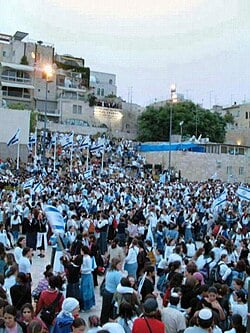
Jerusalem Day (Hebrew: יום ירושלים, Yom Yerushaláyim) is an Israeli national holiday that commemorates the "reunification" of East Jerusalem (including the Old City) with West Jerusalem following the Six-Day War of 1967. It is celebrated annually on 28 Iyar on the Hebrew calendar, and is marked officially throughout Israel with state ceremonies and memorial services. A notable celebration that marks the holiday is a flag-flying parade known as the Dance of Flags. The parade involves flag-bearers marching through the city streets, accompanied by mobile orchestras on trucks playing Hasidic songs. The Chief Rabbinate of Israel declared Jerusalem Day to be a minor religious holiday, as it marks the regaining for Jewish people of access to the Western Wall. Historical background
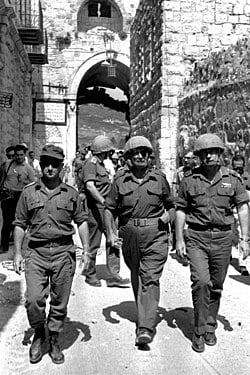
Under the 1947 United Nations Partition Plan for Palestine, which proposed the establishment of two states in British Mandatory Palestine – a Jewish state and an Arab state – Jerusalem was to be an international city, neither exclusively Arab nor Jewish for a period of ten years, at which point a referendum would be held by Jerusalem residents to determine which country to join. The Jewish leadership accepted the plan, including the internationalization of Jerusalem, but the Arabs rejected the proposal. A civil war between Jewish forces and Palestinian Arabs in Mandatory Palestine internationalized in to the 1948 Arab–Israeli War the day after Israel declared independence and the surrounding Arab states sent their armies in to the former Mandate territory. Jordan captured East Jerusalem and the Old City while Israel captured the western section of the city. Israeli forces made a concerted attempt to dislodge the Jordanians but were unable to do so, and the war concluded with Jerusalem divided between Israel and Jordan by the Green Line. The Old City and the rest of East Jerusalem, along with the entirety of the West Bank, was occupied by Jordan, who forced the Jewish residents out. Under Jordanian rule, half of the Old City's 58 synagogues were demolished and the Jewish cemetery on the Mount of Olives was plundered for its tombstones, which were used as paving stones and building materials. In 1967, in the Six-Day War, Israel captured East Jerusalem and the rest of the West Bank from Jordan on 7 June 1967. Later that day, Defense Minister Moshe Dayan declared what is often quoted during Jerusalem Day: This morning, the Israel Defense Forces liberated Jerusalem. We have united Jerusalem, the divided capital of Israel. We have returned to the holiest of our holy places, never to part from it again. To our Arab neighbors we extend, also at this hour—and with added emphasis at this hour—our hand in peace. And to our Christian and Muslim fellow citizens, we solemnly promise full religious freedom and rights. We did not come to Jerusalem for the sake of other peoples' holy places, and not to interfere with the adherents of other faiths, but in order to safeguard its entirety, and to live there together with others, in unity. The war ended with a ceasefire on 11 June 1967 with Israel in control of the entirety of territory of Mandatory Palestine, including all of Jerusalem. On 27 June 1967, Israel expanded the municipal boundaries of West Jerusalem so as to include approximately 70 km2 (27.0 sq mi) of territory it had captured in the war, including the entirety of the formerly Jordanian held municipality of East Jerusalem (6 km2 (2.3 sq mi)) and an additional 28 villages and areas of the Bethlehem and Beit Jala municipalities 64 km2 (25 sq mi). On 30 July 1980, the Knesset officially approved the Jerusalem Law, which called the city the complete and united capital. Celebrations On 12 May 1968, the government proclaimed a new holiday – Jerusalem Day – to be celebrated on the 28th of Iyar, the Hebrew date on which the divided city of Jerusalem became one. On 23 March 1998, the Knesset passed the Jerusalem Day Law, making the day a national holiday. One of the celebrations marking Jerusalem Day is a youth parade with flags known as Dance of Flags, which begins at Gan Sacher, winds through the streets of downtown Jerusalem, threads through the old city and ends with a gathering for a final prayer at the Western Wall. During the parade, flag-bearers are accompanied by mobile orchestras on trucks playing Hasidic songs. One of the themes of Jerusalem Day, based on a verse from the Psalms, is "Built-up Jerusalem is like a city that was joined together" (Psalm 122:3).
In 2015, Yad Sarah a non-profit volunteer organization began organizing a special tour specifically for residents who use wheelchairs, which focuses on Jerusalem history. |





No comments:
Post a Comment