Everybody wants spirituality. To be a good person means to walk in G-d's ways. How does that translate to reality? The only guidebook to spirituality that has stood the test of time is the Hebrew Bible. The Bible says that the Jews will be a light onto the nations. But if you are not a born Jew, you have to convert, which is not so easy!! If you do convert, it is a lot of work to be a Jew (three times a day prayer, keeping kosher, observing the Sabbath).
This blog will show you how to be Jewish without the work!!
Yehuda Lave is an author, journalist, psychologist, rabbi, spiritual teacher, and coach, with degrees in business, psychology and Jewish Law. He works with people from all walks of life and helps them in their search for greater happiness, meaning, business advice on saving money, and spiritual engagement.
Two Jewish organizations working together with the Binyamin Regional Council district rescued the remains of Jewish ancestors desecrated by Palestinian Authority officials whose primary focus was permitting its workers to operate at a site whose legal status under the Oslo Accords wasn't even permissible in the first place.
Even had the site been permissible, the officials issued no warnings or cautionary note regarding the delicate artifacts known to be located at the site.
A circle closed Monday (Dec. 14) that began last year when Regavim's field activities sparked a unique rescue mission: Volunteers for the "Protecting the Eternal" project discovered the Palestinian Authority had issued permits for agricultural work that resulted in the desecration of the ancient burial grounds at the Hasmonean Fortress of Jericho.
During a hike in the spring of 2019 in the Jericho region, volunteers for the "Protecting the Eternal" initiative discovered a burial tomb from the Second Temple era that had been exposed in the course of construction work – and destroyed. The graves were looted and human remains were scattered throughout the area.
The ancient burial caves, dating back thousands of years, are part of the extensive burial grounds of one of the Hasmonean palaces uncovered in the area.
Desecrated Jewish burial ground at the Hasmonean Fortress at Jericho
The volunteers found catacombs plundered, the sarcophagi stolen, and human remains that had been at rest there for more than 2,000 years scattered around the site, which was being plowed and steam-rolled.
Regavim alerted the IDF Civil Administration and a rescue mission was set in motion to collect the desecrated remains and reinter them at the Jewish cemetery in Kfar Adumim.
This week, in a moving and powerful stone-setting ceremony, the operation came full circle in a special section of the Kfar Adumim Cemetery that is set aside for the Kohanim of Jericho by the Binyamin Regional Council.
In that section, Regavim and 'Preserving the Eternal' marked the final resting place of the Hasmonean royal family.
Bringing the desecrated remains to rest with proper respect in the soil of the Holy Land reaffirmed the unbreakable bond between the Jewish People, the Land of Israel, and Jewish history and heritage — the very things for which the Maccabees, members of the Hasmonean royal family buried in the Jericho Fortress — fought more than two millennia ago.
Tallest tower in Israel' to be erected in Ramat Gan after dispute
I recently critiqued an article that used the term "historic Palestine" nine times in 21 pages without offering a definition even once. It is taken for granted that the reader would know what this term means. Not being a historian myself, I asked the historian Prof Amatzia Baram to explain it to me. He responded in an email:
There is no definite "Historic Palestine". It depends on when you are talking about. The beginning, of course, was the three-part Roman Palestine [Palestina Prima, Segunda and Tertia]. The British until 1922 meant both sides of the Jordan River. After that you have British Mandatory Palestine that does not include the east side of the Jordan River. Fatah and the PLO still regard both Jordan and Israel as "Palestine". So did Jabotinsky. Begin no longer did. Everyone and his/her Palestine.
Advertisement
This answer makes sense to me based on my limited experience as an amateur academic sleuth as I critique articles in fields I never formally studied. But will other professional historians agree with Baram? I turned to Google Scholar to see what academic articles were being written on historic Palestine.
There were 3490 results to this search. As I delved into the material, I discovered that this may be an overestimation of the actual published works since there were some duplicate results and some with dead links or otherwise irretrievable materials and not all were necessarily in academic journals. But what was most of interest was whether or not these articles answered the question, what is historic Palestine?
The earliest search result I found using that exact term, "historic Palestine" was published in 1976. The authors are Judaic Studies professor Israel Singer and writer and international affairs consultant Mark Bruzonsky. While their article was published in an apparently well respected magazine, it was not academic. In any case, they implied that "historic Palestine" was Mandatory Palestine before the separation of Jordan given their comment that Prime Minister Rabin would "never consider a third state in historical Palestine".
This is a view repeated in a minority of articles that I looked at.
In his doctoral thesis written in 1987, Elias Kukali, then a student at Dresden Technical University, wrote in several places that "historical Palestine", is everything on the west side of the Jordan River, i.e., Israel, Judea & Samaria (what they call the West Bank) and Gaza. But how can he be taken seriously when you consider this ridiculous statement:
Palestinians … claim that the land is theirs, which they were inhabiting since the Canaanite era, even before the Hebrews guided by Moses left Egypt around 1200 B.C. and invaded their land, Palestine.
There was no such place as Palestine in 1200 BCE. And it is hard to see how Palestinian Arabs can claim to be both Arab and Canaanite. They can be one or the other. But to proudly declare that they are simultaneously part of the Arab Ummah and Canaanites just does not make historical or anthropological sense at all. Kukali is currently a faculty member of the Arab American University in the Palestinian Authority. Thank goodness he is not teaching history or anthropology.
According to a 1930s British Mandate survey, historic Palestine (Israel, the West Bank & Gaza Strip) has a total of more than 35,000 large and small archaeological sites and features (caves, ruins, tells, sanctuaries, quarries, towers, churches, mosques, etc.) from all historic and prehistoric periods.
Note that ancient synagogues do not make it onto Yahya's list of archaeological sites.
At present, there are twenty-one shari'a courts in historic Palestine.
and then he lists 21 cities in Israel, Judea and Samaria, and Gaza. Professor of anthropology and history Ilana Feldman agrees that historic Palestine is comprised of these three regions by defining Palestinians, in her paper in 2019, as "…refugees in exile outside of historic Palestine, Palestinian citizens of Israel, and Palestinian residents of the West Bank and Gaza…"
And this is how the term is used regardless of discipline (psychology, sociology, law, political science, economics and more). So it seems that with regard to "Palestine", history began in 1948. Had it begun for them in 1921, then historic Palestine would have included what became Jordan in 1946.
I find it interesting (and telling) that none of the articles that use the term "historic Palestine" support the existence of Israel as a legitimate state among the world's nations. In fact, those who promote "historic Palestine" are not troubled by the fact that official documents issued by the British (as well as coins and postage stamps) correlate the Hebrew word for Palestine with Eretz Yisrael (the Land of Israel) because they see all of Israel as occupied territory. Even this stamp that commemorates the fifth anniversary of Fateh (Palestinian National Liberation Movement) uses the image of a stamp marked with "Eretz Yisrael".
Also interesting is that the name "Palestine" is associated quite directly to paganism in the first instance and Christianity in the second. Generally a historic people have some connect between their country and their spiritual orientation. Never was the name Palestine associated with Islam.
The pagan Roman Empire, as noted by Baram above, had three Palestinian provinces in their empire: Prima, Segunda and Tertia. This naming shows how uncreative the Romans are and they simply borrowed "Palestine" from the one-time name for a sliver of land along the coast where Gaza is now: Philistia. The Philistines were from the Aegean region and cannot be claimed as Arabs any more than the Canaanites can.
Bernard Lewis was a historian on the faculty at Princeton University. In 1980 he published perhaps the most detailed historical treatment of the name Palestine, while not even once using the term "historic Palestine"; Lewis wrote:
The name Filastin, or Palestine, … had never been used by Jews, for whom the normal name of the country, from the time of the Exodus to the present day, was Eretz Israel.10 It was no longer used by Muslims, for whom it had never meant more than an administrative sub-district and it had been forgotten even in that limited sense. It was, however, widely adopted in the Christian world. In the Middle Ages, Christian writers had usually spoken of 'the Holy Land,' or even of Judaea. The Renaissance and the revival of interest in classical antiquity gave a new currency to the Roman name Palestine, which came to be the common designation of the country in most European languages. European influence brought it to the Arabic-speaking Christians, the first of the country's inhabitants to be affected by western practices and usages. The second Arabic newspaper to appear in Palestine, published in 1911, was called Filastin and was edited by an Arab Christian of the Orthodox Church. [Note added by Sheri Oz: Zachary Foster's recent PhD thesis describes how Russian missionaries to "The Holy Land" in the mid 1800s taught their Arab pupils that they were Palestinians.]
An expression as vague as the Palestine of Christian usage could of course have no very precise geographical definition. The 1910 edition of the Encyclopedia Britannica, published when all these lands were still part of the Ottoman Empire, defines it as follows:
Palestine, a geographical name of rather loose application. Etymological strictness would require it to denote exclusively the narrow strip of coastline once occupied by the Philistines, from whose name it is derived. It is, however, conventionally used as a name for the territory which, in the Old Testament, is claimed as the inheritance of the pre-exilic Hebrews; thus it may be said generally to denote the southern province of Syria. Except in the west, where the country is bordered by the Mediterranean Sea, the limit of this territory cannot be laid down on the map as a definite line. The modern sub-divisions under the jurisdiction of the Ottoman Empire are in no sense co-terminous with those of antiquity, and hence do not afford a boundary by which Palestine can be separated exactly from the rest of Syria in the north, or from the Sinaitic and Arabian deserts in the south and east; nor are the records of ancient boundaries sufficiently full and definite to make possible the complete demarcation of the countries. Even the convention above referred to is inexact; it includes the Philistine territory claimed but never settled by the Hebrews, and excludes the outlying parts of the large area claimed in Numbers xxiv as the Hebrew possession. … The River Jordan, it is true, marks a line of delimitation between western and eastern Palestine; but it is practically impossible to say where the latter ends and the Arabian Desert begins.
It will be noted that this territorial definition differs in several important respects from that laid down for the British mandate only a few years later. For the writer, it clearly includes the east bank of the Jordan as part of Palestine – common usage at the time. In addition, it includes what is now southern Lebanon but excludes the Negev Desert and its extension southwards.
And he ends his article thus:
The Palestine entity, formally established and defined by Britain, was formally abolished in 1948 with the termination of the Mandate. The subsequent history of the idea of Palestine is another story. [emphasis added]
And that takes us back full circle to the beginning of this article.
Just out of curiosity I wondered what I would find if I searched the word "historic" attached to the names of other places under contention today. I will give just two examples of what I found.
… (1) a definable territory with a history of independence or self-governance; (2) a distinct culture; and (3) the will and capability to restore self-governance. The area had a long history of self-governance pre-dating the colonial period.16 In this regard it is revealing that under British colonial rule, Kashmir was granted internal autonomy. The territory of Kashmir has been clearly defined for centuries.17
Regarding cultural uniqueness, the Kashmiri people speak Kashmiri, which, while enjoying Sanskrit as a root language as do all Indo-European languages, is clearly a separate language from either Hindi or other languages spoken in India or Urdu or other languages spoken in Pakistan.18 The Kashmiri culture is similarly distinct from other cultures in the area in all respects –folklore, dress, traditions, and cuisine. Even every day artifacts such as cooking pots, jewelry have the unique Kashmiri style.
Armenia is one of the most ancient countries in the world, existing since the times of Babylon, Assyria and Egypt. In 301 AD, Armenia became the first country in the world to adopt Christianity as its official religion (De-caye and Iskandaryan, 2000).
According to the History of the Armenians by Movses Khorenatsi, in 2107 B.C. the legendary archer, Haik, defeated the army of the Assyrian King Belus and established the first Armenian kingdom. In 1824 B.C., the Armenian princedoms united and came under one authority thus giving birth to the geographic and political concept of Armenia. The first indications of Armenia can be traced in Sumerian cuneiform inscriptions dating back to the 3rd millennium B.C., and the Hittites testify to the existence of a country called Hayasa, which is believed to be the cradle of Armenia. The legendary country consisted of kingdoms of over 60 tribes and included hundreds of towns. The Armenian kingdom is referred to as Ararat kingdom in the Bible. Archeological excavations in the 1950s on the Arin Berd hill within Yerevan city limits revealed a unique and highly developed civilization in the Araratian kingdom of Urartu (Ararat) (Ministry of Industry and Trade, 1998, p. 3).
Compare these with "historic Palestine" which apparently dates back "as far as" 1948 or at most 1920. And compare the description of the Kashmiri and Armenian people with the "Palestinians", the latter of which is unique among those who call themselves a "people" for having no language of their own, no culture distinct from that of their Arab neighbors, and did not even call themselves Palestinians until the Jews threatened their peace of mind with the audacity of returning to their indigenous homeland and seeking sovereignty over it.
The Jewish holiday of Chanukah has two major symbols: the menorah and the dreidel.
The menorah, a candelabra with eight branches, and one light above, memorializes the liberation of the Temple from the religious persecution of Antiochus IV Epiphanes, the Syrian-Greek ruler who had outlawed Judaism, and the other a spinning top recollects how Jewish children learning the word of G-d in the banned 'hedge schools' of ancient Israel would take out tops and pretend to be playing games when Antiochus' inspectors arrived.
American Jewish children had lit menorahs and spun their dreidels for generations without imagining that an Antiochus would arise in America. Let alone that he would arise in New York.
In 2020, Chanukah came early when another abominable tyrant, fresh from killing 11,000 nursing home residents by forcing facilities to accept infected coronavirus patients, decided to adopt the medieval habit of blaming the virus on Orthodox Jews in Brooklyn. A swarm of inspectors from every department were sent out to schools and then to the hidden schools.
And in 21st century America, children huddled in basements, afraid to make a noise, and then, if Cuomo's men found them, were ready to claim that they weren't in school, just playing games.
A month before Chanukah and Christmas, the Supreme Court's conservative justices, three of them appointed by President Trump, delivered a Christmas present in Roman Catholic Diocese v. Cuomo and a Chanukah present in Agudath Israel of America v. Cuomo. Like his Syrian-Greek predecessor, Cuomo furiously raged at the restraint imposed on his power.
Cuomo's hatred for religion is driven by the same mad idolization that had led Antiochus to take Epiphanes, 'the visible god', as part of his name. Antiochus had put idols in the temple, Cuomo had placed his self-idolizing coronavirus memoir into the windows of every bookstore.
That egotistical hatred of a G-d that isn't a culture war idol, that isn't named Cuomo, Obama, or Ginsberg, is why the battle for religious freedom is far from over in this longest of Chanukahs.
When the pandemic lockdowns arrived, I was still completing the mourning year for my mother. In Jewish tradition, losing a parent ushers in a year of grief. I did not listen to music or attend parties, and I spent an hour each day traveling to synagogue to lead prayer services in her memory. The recital of the Kaddish, praising G-d, is said to uplift the souls of the deceased.
And then all the synagogues were forced to close.
In a dark time when the New York Post dispatches undercover investigators to do Cuomo's work for him and spy on Jewish weddings, when the media breathlessly digs up tales of secret prayer gatherings ("Post the names and addresses, expose them," a quote in one Los Angeles article read, "If you have information and say nothing then you could be endangering lives"), few dare to speak of the underground prayer railroad. But what more needs to be said of the state of 21st century America than that there were underground churches and synagogues.
My mother was born in the Soviet Union. As a teenager, she had terrified her parents, who had witnessed their family members being imprisoned and executed, by rejecting Communism. After being expelled from school and barred from higher education, she had joined the Jewish underground networks that had gathered together in homes to sing Jewish songs, to illegally copy Hebrew dictionaries, commemorate the Holocaust, and covertly bake Matza for Passover.
Americans tend to think of such a loss of freedom as an alien and unimaginable state. This year taught us how thin the line that divides us from the age of Antiochus or the age of Stalin really is.
For now, the synagogues are open again and many of the religious schools in Los Angeles are teaching students though some, in an echo of the dreidel, are operating officially as day camps.
The Supreme Court decision that halted some of the declarations by the modern Antiochus and his Democrat peers that religion, unlike cannabis dispensaries and film shoots, is non-essential, would not have happened if President Trump and Senate Republicans hadn't put Justice Amy Coney Barrett on the Supreme Court. When religious freedom hangs by the fraying thread of a single justice, even as Democrats plot to seize Georgia Senate seats and pack the court, then it's hardly there even if for the moment some of the worst Democrat depredations were halted.
The tragic truth is that if Justice Ruth Bader Ginsburg were alive today, Chanukah would be cancelled. It would be cancelled with the connivance of her, and of Justice Breyer and Justice Kagan, much as Christmas would be cancelled with the connivance of Chief Justice Roberts and Justice Sotomayor. The irony of Tikkunolamists of Jewish descent lighting a menorah shaped like Ginsburg, to honor an activist who would have cancelled Chanukah escapes them, much as the problem with sacrificing pigs in the temple baffled Antiochus' Jewish collaborators
Tikkunolamism is the modern Hellenism, a militant pagan secularism that idolizes utopian culture heroes while disdaining the intangible idea of the holy presence of an unseen G-d.
Antiochus placed idols in the temple and ordered that pigs be sacrificed because he only understood religion as power. To defile something sacred was to wield power over it. In their culture wars, leftists follow the same obsessive pattern of degradation, using elephant dung and urine on Christian symbols, draping naked women in the symbols of the Jewish faith, ridiculing Chanukah in the pages of the New York Times, and making the menorah into a mockery.
And when that doesn't work, there's always compulsion under the guise of a greater good.
Antiochus had taken the surname Epiphanes, meaning 'the visible god', to mock the invisible G-d. But the power of G-d had made a mockery of his armies, his blasphemies, and his rule.
The power of Chanukah, and of faith, is in the unseen, from the force that caused a single flask of oil to burn in the Menorah for eight days, to the covert Torah being studied by the children as they pretended to spin a top, to the hidden omnipotent might of an unseen G-d.
And this year, the suppression of public prayers made us appreciate them all the more.
Religious freedom and all that comes with it is all too often taken for granted. It can be difficult to relate to our ancestors who sacrificed so much for their faith when we don't need to sacrifice. When the mandates, decrees, and lockdowns came down, we saw the unseen, the preciousness and precariousness of our religious freedom, that we had taken for granted.
Out of the dark times, we experienced the smallest taste of what our ancestors had endured to keep the faith, and through that renewed the meaning to be found in holidays like Chanukah.
Religious people respond to religious persecution by seeing the unseen. It is the unseen that is the source of faith in a world that places its confidence in material power above all else. And the insights and the might of the unseen make a mockery of the worst of that blasphemous power.
Another Chanukah arrives in a world in which Antiochus can be found in Albany, New York, in which the synagogues and schools open today might be forced to be shut tomorrow, and in which the ideological faction that makes a point of defiling Chanukah along with most religion, which would close most houses of worship if it could, plots to lay claim to the White House.
When George Washington visited the family of a Jewish officer, a story relates that he told them of first encountering the Menorah in the hands of a Jewish soldier at Valley Forge.
"Perhaps we are not as lost as our enemies would have us believe. I rejoice in the Maccabees' success, though it is long past," Washington had supposedly said. "It pleases me to think that miracles still happen."
Even in the darkest period of a dark year, we are not as lost as our enemies would have us believe. Neither the trials nor the triumphs of faith are long past. And miracles still happen.
Even after Israel entered its third nationwide lockdown on Sunday afternoon, members of the Knesset Constitution, Law and Justice Committee were still duking out the details. It wasn't until Monday at noon that the current restrictions were approved by a vote of 8-7. And even those were altered somewhat.
Advertisement
Ironically, just as many Israelis flooded hair salons and malls ahead of the latest closure as they have been lining up to get vaccinated. But at least the latter is being carried out with startling efficiency. Indeed, Israel is leading the world in the number of vaccines distributed per capita.
The opposite applies to the former. As has been true since the coronavirus pandemic hit the shores of the Jewish state at the end of February, the public is still being made bonkers by the arbitrary nature of the rules. It's no wonder, then, that people have been making up their own.
Why there is even a need for a third lockdown, particularly with the vaccination campaign underway—one that has run totally counter to polls a few weeks ago showing much of the population unwilling to be inoculated—is a question that naturally arises.
Subscribe to The JNS Daily Syndicate by email and never miss our top stories
Israeli Prime Minister Benjamin Netanyahu's answer, basically, is that there is a dangerous spike in the rate of COVID-19 infection, accompanied by a rise in the number of patients on ventilators and an increasing death toll. He and Health Minister Yuli Edelstein have been warning against complacency and urging the public to let the new combination of lockdown and vaccines work its magic.
This is of little comfort to small-business owners, devastated financially by the first and second lockdowns. Many have expressed resentment about being shut down when the "fault" for the coronavirus surge seems to lie, among other things, with the Israelis who were allowed to flock to the United Arab Emirates—in the wake of the Abraham Accords—only to return home carrying COVID along with their luggage.
The debate is often portrayed as "health versus diplomacy" or "health versus the economy," with politicians and medical professionals weighing in ad nauseam, and adopting an array of positions. Naturally, confusion has spread even faster than the new variant of the virus detected on Dec. 8 in the United Kingdom and subsequently discovered to have "made aliyah" as well.
The depiction of the controversy is incorrect, however. It turns out that there are many doctors who dispute their public-health colleagues' doomsday scenarios—or, rather, consider the damage of lockdowns to outweigh their efficacy.
In a letter to the Knesset's Constitution, Law and Justice Committee, the Public Emergency Council for the Coronavirus Crisis—made up of medical experts and senior researchers—blasted the information on which the decision to impose another lockdown at this time was made. The document submitted to the Knesset, the physicians wrote, "is riddled with 'alternative facts' and irrelevant data, which … can only be defined as irresponsible, partial and unprofessional."
The scathing missive—signed by more than 100 health specialists, among them Nobel Prize laureate Aaron Ciechanover, infectious-disease and immunology expert Zvi Bentoitch (a pioneer of AIDS treatment in Israel) and Emet Prize winner Zahava Solomon, an expert in psychiatric epidemiology and post-trauma—rebutted the following seven claims:
The first was the assertion that the effect of the vaccines will only be felt in a few months. According to the signatories, this is misleading. They argued that the full, two-dose inoculation of at-risk sectors (some 1.2 million people) can be completed within about five weeks, almost completely severing the connection between confirmed COVID-19 cases, critical patients and the death rate.
The second was the voiced statistic of "11,000 critically ill patients and an increase of 90 every day."
"At the time of this writing," the authors of the letter pointed out, "the number of serious patients was 539. If [this figure was referring to the total since the onset] of the pandemic, then it is in no way relevant to the decision to impose a lockdown." The actual number, they said, is much lower, with an average increase of seriously ill patients hovering at eight to nine per day.
The third was the "false" statement that about 20 patients die of the virus every 24 hours.
"While every individual is a world [unto himself]," the experts wrote, "and while every death is a tragedy and source of pain for the family, the 20-deaths threshold was crossed only once throughout the month of December. [Furthermore], it is important to note that in an average year, 1,000-1,300 [Israelis] die from flu-like illnesses and more than 5,000 from pneumonia, most during the winter. This figure reflects an average daily mortality rate of 14 [in other months of the year], and an average of 20 in winter."
The fourth claim they dismissed was that the number of new cases diagnosed daily is on a steep rise.
The link between the number of verified cases, and severe morbidity and mortality is limited, they said, and a rise in the former does not automatically indicate an increase in the latter. One reason for this, they explained, is that the amount of verified cases depends largely on the number of tests conducted. Another, they added, is that many of those diagnosed with the virus experience mild or no symptoms.
The fifth was the claim that some of the hospitals are already overloaded with coronavirus patients.
The doctors insisted that the burden on hospitals this month is actually very low compared to that of previous years. According to these medical experts, the average occupancy of Israeli hospitals in December is 120 percent, and often reaches 150 or even 200 percent. This month, in contrast, most hospitals are below 14 percent occupancy, and 90 percent of the 24 hospitals from which the information was taken are below 70 percent.
"By all accounts, winter 2020 is one of the least busy the health system has experienced in recent years," they wrote.
The sixth had to do with the fear that the new strain(s) of the virus will impair the effectiveness of the vaccine.
The signatories of the letter assured that not only is this possibility low, but it runs counter to statements made by Health Ministry Director General Hezi Levy and other government figures, who announced that the vaccine probably works against the mutation.
The seventh claim with which they took issue was that the financial impact of lockdowns is irrelevant when calculating people's health. They argued that the cost of closing the economy for two to three weeks is around 26 billion shekels (approximately $8 billion), which equals the price of more than 40 annual health baskets or more than the establishment of 10 new major hospitals.
Other than taking a welcome ax to conventional coronavirus wisdom, these reliable scientists were saying, in lay terms, that Israel may well have been cutting off its nose to spite its face throughout this entire crisis. Clearly, we'll only know for sure when future analysts collect and dissect the data in retrospect.
The good news is that Israelis—whose modus vivendi is to rely on the nanny state for rules to bend and negotiate—are self-motivated to receive the vaccine. It's the kind of closure about which there is near-universal agreement.
See you tomorrow bli neder as we continue this useless lockdown costing Israel 2.5 billion per week
Yehuda Lave is an author, journalist, psychologist, rabbi, spiritual teacher, and coach, with degrees in business, psychology and Jewish Law. He works with people from all walks of life and helps them in their search for greater happiness, meaning, business advice on saving money, and spiritual engagement.
like the Chanukah miracle Israel approves using extra doses in Pfizer vials to vaccinate more persons
Health Ministry okays use of up to 6 doses per bottle, which could significantly boost vaccine supply; PM hopes that by next weekend, 100,000 Israelis will be immunized a day
The Health Ministry gave approval Thursday to healthcare providers to extract up to six doses from vials of Pfizer's COVID-19 vaccine rather than the five currently permitted, according to Hebrew media reports.
The reported change could significantly increase Israel's supply of the vaccine, allowing it to immunize a greater number of people. If all Pfizer vials set to reach Israel in the coming months have the extra dose, it could mean an additional 800,000 people can be vaccinated.
The Health Ministry gave approval Thursday to healthcare providers to extract up to six doses from vials of Pfizer's COVID-19 vaccine rather than the five currently permitted, according to Hebrew media reports.
The reported change could significantly increase Israel's supply of the vaccine, allowing it to immunize a greater number of people. If all Pfizer vials set to reach Israel in the coming months have the extra dose, it could mean an additional 800,000 people can be vaccinated.
Earlier this month, the US Food and Drug Administration confirmed some vials of Pfizer's vaccine were overfilled and contained enough doses for seven people. It told health officials to use every full dose possible "given the public health emergency."
Each dose is supposed to contain 0.3 milliliters of the vaccine. Each vial was supposed to contain five doses, but many have been found to have more.
Chezy Levy, the director-general of the Health Ministry, said Thursday that 180,000 Israelis had been vaccinated against the coronavirus over the past five days.
In a press briefing ahead of a nationwide lockdown set to begin Sunday, Levy said 40,000 had so far been vaccinated Thursday and that 65,000 received vaccines on Wednesday.
"The goal is to vaccinate at least four million people during the first quarter of 2021," he said, according to the Ynet news website. "We have enough vaccines to do it, and I hope we'll fulfill that goal."
Levy also said Israelis won't be prevented from getting inoculated during the lockdown.
According to the Oxford University-based Our World in Data website, Israel is second in the world in the number of people per capita to receive the vaccine, trailing Bahrain.
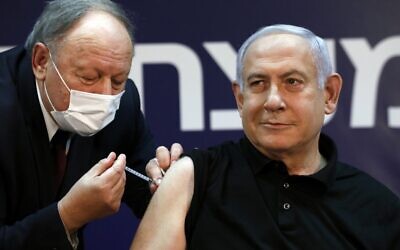
Prime Minister Benjamin Netanyahu
receives a coronavirus vaccine from his personal physician Dr. Tzvi
Berkovitz, at Sheba Medical Center in Ramat Gan, on December 19, 2020
(Amir Cohen/Pool/AFP)
Prime Minister Benjamin Netanyahu said Thursday that he hoped up to 100,000 Israelis would be vaccinated every day by next weekend, while Health Minister Yuli Edelstein instructed Levy to meet that goal by having healthcare providers administer vaccines 24 hours a day, seven days a week.
"I want to tell you that the combination of the marvelous vaccine campaign on the one hand, and a short and quick lockdown on the other, will allow us to get out of the coronavirus [pandemic] and we'll likely be the first country to get out of [it] in a few weeks," Netanyahu said in a statement.
On Wednesday the Health Ministry said hospitals would begin administering vaccines to the public next week, joining the country's health maintenance organizations that are leading the effort. A ministry statement said the move was aimed at "significantly" increasing the pace of the vaccine drive. It didn't say how Israelis could schedule an appointment to be vaccinated at hospitals or provide any further details on the move as of yet.
The national vaccination program began on Sunday, with medical workers getting the first injections. Starting Monday, vaccinations were opened up to those aged 60 and up, as well as those in risk groups.
The government has not yet specified when the vaccines will be made available to the wider public.
The Three Musketeers at the Kotel
RABBI SCHWARTZ'S REALLY AGING BIRTHDAY JOKES OF THE WEEK Not long after attending her grandson Paul's 12th birthday party, Rebecca has a heart attack. Whilst in hospital, she starts to plead with her cardiologist. "Oy, doctor David," she says, "you've just got to keep me alive for the next 12 months so that I can attend my bubbeleh grandson Paul's bar mitzvah. He's my first grandchild." "I'll do my utmost to get you there, Rebecca," says doctor David. "Thank you, doctor," says Rebecca. And 12 months later, Rebecca does indeed attend Paul's bar mitzvah. Ten years later, whilst Rebecca is seeing doctor David for a check-up, she says, "I have another request, doctor." "And what do you need me to do this time, Rebecca?" he asks. "In a year's time, please God, my grand-daughter Suzy is marrying a lovely, lovely, man, a real mensch, and I desperately want to attend their wedding. So please, doctor, please ensure that I stay alive long enough to attend their wedding." "I'll do my utmost to get you there, Rebecca," says doctor David. "Thank you, doctor," says Rebecca. And 12 months later, Rebecca does indeed attend Suzy's wedding. Over the next twenty years, Rebecca regularly visits doctor David for check-ups, and she always religiously follows his advice. Then one day, she suddenly phones doctor David. "Hello doctor," she says. "It's Rebecca here." "Are you OK Rebecca?" asks doctor David, sounding worried. "Is anything the matter?" "Nothing's the matter doctor," replies Rebecca, "I think everything is OK and I'm feeling fine. But I'm calling because I have another request to make. Do you remember when you enabled me to attend my grandson's bar mitzvah?" "Yes Rebecca, I do," he replies. "And do you remember when you enabled me to attend my granddaughter's wedding?" "Yes Rebecca, I do," he replies. "And are you aware that I've just celebrated my 80th birthday?" asks Rebecca. "Yes Rebecca, I know," he replies. "Well, I'm ringing you because I've just taken delivery of a new mattress," says Rebecca. "Mazeltov," says doctor David, "but why are you phoning me about your mattress?" "Because," replies Rebecca, "the mattress came with a 20-year guarantee!"
Old Moishe Applebaum goes to his doctor complaining of aches and pains all over his body. After a thorough examination, the doctor gives him a clean bill of health." Moishe, you're in excellent shape for an 85-year-old man. But I'm not a magician – I can't make you any younger," says the doctor."Who asked you to make me younger?" says Moishe. "You just make sure I get older!"
The Jewish Chronicle had heard that Benjy was coming up to his 108th birthday so they sent one of their reporters to interview him. "How do you account for your longevity?" asked the reporter. "You could say that I am a health nut," Benjy answered. "I have never smoked or drunk alcohol, I am always in bed by ten o'clock, I've been going to Israeli dance classes since I was a teenager and I've always walked three miles a day, even in rain or snow." "But," said the reporter, "my uncle Shlomo followed exactly the same routine and he died when he was 70. So how come it didn't work for him?" "All I can say," replied Benjy, "is that he didn't keep it up long enough."
Avrahom walks into a department store and goes straight to the perfumery department. He says to an assistant, "Today is my wife Sharon's birthday and I would like to buy her a nice bottle of French perfume. The assistant says, "That will be a nice surprise for her." Avrahom replies, "It sure will – she's expecting a diamond necklace."
At his 103rd birthday party, the Rubenstein family gathered around Zadie Hymie for cake and words of wisdom."So Zadie," asked little Stevie inappropriately, "Are you going to be around for your 104th Birthday party"?"I certainly will," Zadie replied."How can you be so sure?" Stevie asked."Well," Zadie replied, "Statistics show that very few people die between the ages of 103 and 104."
Herman Cohen was horrible with birthdays and anniversaries. He couldn't remember them for the life of him so he decided to compile a list so that every time he turned on his computer the dates would be highlighted on screen. Even this didn't work well enough so Herman went to a computer store to find a software program that would do the job. He approached one of the sales clerks who looked more senior. "Can you recommend something that will remind me of birthdays and anniversaries?" Herman asked."Have you tried a wife?" he replied.
RABBI SCHWARTZ'S REALLY TERRIBLE BAGEL JOKES OF THE WEEK
What kind of bagel can fly? A plain bagel
How do you hold a bagel back? You put lox on it
Why do seagulls fly over the sea? If they flew over the bay, they would be bagels!
Why did the bagel lose the election? He was the victim of a schmear campaign
What does a bagel do when it can't get into its house? Call a loxsmith
What do ghosts put on their bagels? Scream Cheese
What did the bagel say to the Rabbi? I'm holier than you
What does a Yeki bagel call its grandfather? Poppy!
What do you call a bagel in fancy dress? A donut
Why should you never start up with a Jewish Bagel maker? He knows Jew Dough
I had to take a drug test at work today. They said they found Opiates. I told them it was probably the poppy seeds on my bagel. But then they asked about the THC, methamphetamines, cocaine, and hallucinogens. I told them it was an everything bagel.
What kind of bagel did the camper eat? A Winnebago.
The German consulate is in NYC for a big UN meeting with his Israeli counterpart The clock hits 12:30 and the meeting breaks for lunch. Being that he's in New York, the consulate requests to go out to lunch at a local Deli. Yoav the intern is charged with taking him out. As they are sitting and eating the consulate turns to the intern and exclaims, "I have to admit, these bagels are really delicious! We don't have bagels like this in Germany." Well," the intern replies, "whose fault is that?"
An elderly couple is sitting in the living room, and the old man gets up, and says "I'm going to the store to get myself a soda, do you want anything?"His wife says "I'd like an ice cream sundae. Here, I'll write it down for you so you don't forget--"I'm not going to forget," he waves his hand at her dismissively. "Ice cream sundae."With cherries and chopped nuts. You'll forget, I'm going to write it down for you. "Woman I'm not senile! I won't forget! Sundae with cherries and nuts."And whipped cream. You're sure you won't forget all this? You forgot the last time. Please, I'll write it down so you won't forget."The old man gave an annoyed sigh and left the house. He returned and handed his wife a bag."Here you go, I didn't forget."She looked inside the bag and found a toasted onion bagel."Yes, you did! I told you you would forget, and you did!" The old woman threw a fit. "You forgot the cream cheese!"
A man is the head of a popular bakery in New York. The most popular thing they sell is their bagels, but the main bagel chef is out of town, so there are no bagels today. One old woman has asked repeatedly if there are bagels, to which the answer is always no. For some reason, she keeps going to the back of the line and asking over and over if there are bagels. The woman comes up to the front and once again asks for bagels. The man has had quite enough and asks her: "Ma'am, how do you spell cat as in Catastrophic?"She replies "C A T"He asks her "how do you spell dog as in Dogmatic?"She replies "D O G"The man then asks her "how do you spell stink as in Bagels?"The woman, confused, says "there is no stink in bagels" to which the man shouts"THAT'S WHAT IVE BEEN TELLING YOU THIS WHOLE TIME!"
Kamala Harris Explains What Hanukkah Is; Ben Shapiro Reacts
David HaMelekh May have been a Warrior, but he was NO PC Warrior
Every now and then I have a personal experience with Politically Correct thought.
Three times daily, we recite Psalm 145 (Ashrei). King David , in his conversation with God writes," God watches over the righteous and destroys the wicked." Many of David's appeals to God contain this theme.This prayer and similar ones make some Jews feel uncomfortable. Destroy the wicked? It sounds so judgmental, so vengeful. how distasteful is that!Perhaps because of this growing phenomenon, I make sure to read that passage aloud when I lead the service.I have a good idea as to which of the congregation behind me welcomes hearing the passage that makes a clear distinction between good and evil, and which ones cringe when hearing it.This morning one of them mocked aloud, "Shalom thinks that if he doesn't say the passage aloud, God won't act."I answered, " If David felt it was important enough to write it should not be hidden." God can also act without written prayer, but David thought it important to write for posterity and our daily awareness. "David was not PC. He was not as sensitive or sophisticated as some of our "progressive" teachers today. If King David lived in our generation with those same outmoded ideas, he would be shunned and mocked by "sophisticated" Jews.I am reminded of what I heard from a "Progressive" rabbi some years ago.He led a very liberal, Anglo congregation in Katamon.He said that he would love to delete the "Av Harachamim" prayer that we say on Shabbat.This prayer was written by the survivors of the massive Crusades massacres in Germany eight hundred years ago.Ashkenazi Jews say it every Shabbat since.The prayer recalls the suffering at the hands of the merciless Crusaders and calls for revenge for Jewish blood that flowed like water.The progressive rabbi wanted to shield his sensitive congregation from harsh words as these.After all, it was over eight hundred years ago, Let go!Talk about nice things. I wonder what progressive rabbis will say about remembering the holocaust in a few centuries( or decades) from now?No; I think I will continue to repeat the words of David's prayers aloud despite the sensitivities of my more sophisticated friends.
When Two-Year-Olds Are Thrown Off Airplanes, You Know America Has Changed
You may have seen the video of the family thrown off a United Airlines airplane because the two-year-old daughter would not wear a mask. Though the family wore masks and the father promised to cover his daughter's face with a mask that he placed on her face, it made no difference.
Though the child was completely asymptomatic, and though it is exceedingly rare for a child to transmit Covid-19 to an adult – that is why Sweden kept its schools open all spring and summer, with its students not wearing masks – the airline had its orders, and the flight attendant duly obeyed them.
As I watched the video, I wondered what the flight attendant thought. For example, did he think this was absurd, not to mention cruel? Did he know that two-year-olds present virtually no health risk? Did he wonder why adults can sit without masks inches from other passengers while eating but a two-year-old seated only next to family needed a mask?
Or did he think he was performing a noble service in kicking a family off an airplane because their two-year-old wouldn't wear a mask?
I hope he thought he was enforcing an idiotic rule and had no choice. Then there is hope for him and for America. Otherwise, he's an irrational automaton, among the scariest people in any society.
Does United Airlines think it's enforcing a rational and humane policy, regarding two-year-olds as dangerous disease spreaders?
Here is what we can assume:
United Airlines has made the calculation that if it doesn't enforce every directive from the Centers for Disease Control and Prevention, two bad things will result: 1) People will be too scared to fly United; 2) If anyone gets Covid-19 after a United flight on which a two-year-old was allowed to fly without a mask, the airline will be sued.
Regarding children and mask-wearing, the CDC website states, "Masks should NOT be worn by children under the age of 2." The CDC capitalizes "NOT."
So, while the CDC is adamant children under the age of two must NOT wear a face mask, a child who just turned two constitutes a mortal danger to others on the plane – and must be ejected from the plane if she just won't cover her face.
Welcome to America in 2020.
It is not overstated to declare the year 2020 the year it became legitimate to question whether America could still declare itself either "the Land of the Free" or "the Home of the Brave." Maybe it really is time to replace the national anthem with some other song that doesn't have us singing what so many of us no longer believe in.
When half of America sings those words, they are no longer referring to themselves or what they want America to be. About half of us – more or less, the half that voted Donald Trump for president – still believes that America should be the Land of the Free and Home of the Brave. But half of us, including the entire elite – the major media; the entire educational system from elementary school through graduate school; national, most state and all major city bureaucracies; and the Democratic Party – neither value freedom nor seek to be brave.
When I see Americans walking outdoors with masks on, my first reaction is to mourn the death of reason and my second is to wonder what college they attended. Because one of the many other awful things colleges do to most of their students is make them afraid: afraid not only of dying if they pass another human being while walking their dog but also of dying from global warming, and afraid of any ideas not inculcated into them by their school.
That's why they and most of their professors object to conservatives speaking at their school. To the brainwashed, different ideas are frightening and make them feel "unsafe" (hence, "safe spaces" at so many colleges).
When viruses killed the equivalent of about 165,000 Americans in 1968 and about 225,000 in 1957 (numbers adjusted based on the current U.S. population), healthy Americans did not quarantine; no one hid behind masks; no school closed; no store or restaurant went out of business. Why? Because people understood that viruses and death are tragic parts of life, and it never occurred to them to deprive children of their studies, their friends, and their childhood.
It didn't occur to Americans that because some people contracted a virus and died, 99 percent of the population should stop living and earning livelihoods. In that America, the news media were not singularly dedicated to frightening Americans. And most important, the left had not yet succeeded in ruining the country; after all, far fewer Americans went to college at that time, and high school and elementary school teachers still viewed their vocation as a call to teach, not indoctrinate.
All of this explains how we got to the place where United Airlines could throw a two-year-old girl off an airplane while presumably, half the passengers supported her eviction and the other half was cowed into silence.
On December 9, 1917, British forces accepted the Turkish surrender of Jerusalem. Two days later the British officially entered the walls of Jerusalem.
As the world was engulfed in brutal armed conflict of an unprecedented scope, fighting raged in the Holy land between Allied troops and the Ottoman-Turks (allied with the Central Powers) who had ruled the land for most of the past 400 years. On October 30 the strategic city of Beer Sheva fell to the allies who then drove towards Jerusalem.
Advertisement
A London dispatch on November 24, reported that the Mosque containing the tomb of the prophet Samuel was bombarded. The ancient site of Mitzpeh, 5,000 yards west of Jerusalem-Nablus road has been stormed by the British. (American Jewish Chronicle, November 30, 1917, p. 91)
The major battle for Jerusalem was in full swing. British cavalry fought their way into Jerusalem. In the words of a commander,
"When 'charge' sounded I think every man went stark mad. Guns were belching their shells at us in one sheet of flame and bullets by thousands swept past, but no man seemed to get hit as on we went, with drawn swords flashing in the sun, in a long straight line, horses going like mad and everyone shouting like fury. Now, we could see some of our pals falling, yet straight at the guns we charged." (American Jewish Chronicle, February 15 1918 p. 408)
In the battles for Jerusalem, twenty thousand Turkish soldiers, and three thousand six hundred British and allied troops lost their lives. On December 11, the second day of Chanukah, British troops marched into Jerusalem. British commander and chief, General Edmund Allenby respectfully entered its walls by foot through the Jaffa gate as the city's thirty-fourth conqueror.
Excited crowds lined Jerusalem's streets to welcome the city's liberators. Their very presence signified an end to the terrible suffering the people of Jerusalem had endured during the war.
One British officer described his entry into Jerusalem and the reception by its residents, "People of all ages and apparently of all nationalities, thronged the roadway, crowded at their doors and windows, and squeezed themselves on the roofs of their houses. Swarms of children, Arab, Jew, and Christian, ran with us as we marched along, and the populace clamored to any point of vantage, waving and clapping their hands, cheering and singing. Jews clad in European dress came running up, singled out any one of us, wrung him by the hand, and –talking excitedly in broken English-said that they, the people of Jerusalem, had been waiting for that two and a half years. (Bernard Blaser, Kilts Across the Jordan, H.F.& B. Witherby, London, 1926, p. 120)
A Jewish periodical, The London Jewish Chronicle, headlined the event as 'The Rising of Jerusalem," describing the allied conquest as an "Epochal event." Rabbi Hertz, chief Rabbi of the British Empire issued a statement linking the British entry into Jerusalem to the holiday of Chanukah, "Jerusalem which for ages has been the majestic pole of love and reverence of the world is now in British hands. And this soul thrilling news reaches us on the day that the Jews are celebrating the Maccabean festival. On this day 2,080 years ago the Maccabees freed the Holy City from the heathen oppressor and thereby changed the spiritual future of humanity. Who knows but that today's victory may form as glorious a landmark in the history of mankind."(London Jewish Chronicle, December 14, 1917, p.24)
Zionist leader Chaim Weitzman who played a significant role in the negotiations leading to the issuing of the Balfour Declaration just six weeks earlier, which called for a Jewish homeland in the Land of Israel, phoned the London Jewish Chronicle and stated, "The news of the British victory will raise the hopes of Jews all over the world. It opens the prospects of the realization of hopes which have existed in their kinds for centuries."(Ibid.)
On the day of the taking of Jerusalem, the citizens of the city woke up early and went out to the streets; first with hesitation just to see if indeed the Turkish front had indeed fallen. Then as if in a dream, to see the crowds, emerging from their "holes" and all marching west (to the Jaffa Gate) to witness the ceremony in which the city is passed to the British conqueror. And then the city was joyful and rejoiced. (David Benveniste, HaGedud HaIvri: Bimei Milchemet HaOlam HaRishona: Yoman, B'iton HaTzibur HaSephardi Va'Edot HaMizrach, Jerusalem, 1977, p. 5)
It would take time for the city to recover.
In the first month after the surrender, not much had changed. The residents have not yet recovered from the famine which had devastated the city during the war and were not healed from their sicknesses. Young school students were still distant from their parents in the fighting countries. Everybody was waiting for additional aid that would hopefully come from afar. In the meantime, the communication with the Tel-Aviv Jaffa residents was renewed. They were liberated a few weeks before Jerusalem was freed.
However, the city began to be revitalized. New infrastructures and facilities were constructed. Significant quantities of wheat were imported from Egypt every month by the recently appointed military governor of Jerusalem, Ronald Storrs. Pipes were installed to allow water to be brought into the Old City of Jerusalem.
A noticeable sign of revitalization and growth was when the cornerstone to the future Hebrew University was laid upon its future site on Mount Scopus on April 10, 1918.
Jerusalem had yet again endured.
Seventy-five years later, on December 10, 1992, Jerusalem resident Anna-Grace Lind again watched Allenby stride into Jerusalem. This time, Viscount Allenby, the general's great nephew, entered the city with Jerusalem's Mayor Teddy Kollek. Events commemorated the 75th anniversary of Ottoman surrender to the British. Kollek stated, "The British were welcomed equally by Jews, Christians, and Muslims, all of whom suffered under 400 years of Turkish rule." (JTA, December 10, 1992)
Today, the Jaffa Gate is a reminder of the scene of the triumphant march into Jerusalem.
Life was restored but the terms of the Balfour Declaration calling for Jewish Statehood would not be honored necessitating a difficult struggle for the Jewish homeland.
Larry Domnitch and his family lives in Efrat
See you tomorrow bli neder
We are in the middle of another knockdown so we really need Moshiach now!