Everybody wants spirituality. To be a good person means to walk in G-d's ways. How does that translate to reality? The only guidebook to spirituality that has stood the test of time is the Hebrew Bible. The Bible says that the Jews will be a light onto the nations. But if you are not a born Jew, you have to convert, which is not so easy!! If you do convert, it is a lot of work to be a Jew (three times a day prayer, keeping kosher, observing the Sabbath).
This blog will show you how to be Jewish without the work!!
Yehuda Lave is an author, journalist, psychologist, rabbi, spiritual teacher, and coach, with degrees in business, psychology and Jewish Law. He works with people from all walks of life and helps them in their search for greater happiness, meaning, business advice on saving money, and spiritual engagement.
Welcome to Biblical Mount Ebal By Nosson Shulman -
photo Credit: Wikimedia
Mt Ebal
"And it will be, when the Lord, your God, will bring you to the land to which you come, to possess it, that you shall place those blessing upon Mount Gerizim, and those cursing upon Mount Ebal (Deuteronomy 11:29)"
"Then Joshua built an altar to the Lord God of Israel on Mount Ebal (Joshua 8:30)"
Altar built by Joshua located on Mount Ebal
Today we are visiting Mount Ebal, a special biblical site (whose structure is mentioned explicitly in the Bible). This site is breath taking, but seldom visited due to certain security concerns and its unique geo-political location. In order to visit, one must have an IDF escort. While the nearby Tomb of Joseph (for more on that site, click here) also requires an IDF escort, a monthly escort is arranged in advance. Mount Ebal has no set schedule, rather one has to arrange for it privately. Getting IDF permission can take several months. However, the privileged few who get to visit are certainly happy that they made the effort!
Mount Ebal To its left is biblical Mount Gerizim (mountain of blessings). The large city in the valley is Nablus (biblical Shechem). For those who are unable to arrange an IDF escort to Mount Ebal itself, the next best way to experience these Biblical sites safely is from the Jewish settlement of Elon MorehPhoto Credit: Wikimedia
Even before the Children of Israel entered the Holy Land, Mount Ebal was chosen to be the site of a prominent Biblical event. Moses told the people that when they were to cross the Jordan River into Israel, there would be opportunities for blessings (if they listened to and followed G-d's commandments) or curses if the opposite, G-d forbid, was done. The actual blessings and curses were to be pronounced on Mount Gerizim (blessings) and Mount Ebal (curses) immediately upon entering the land (see Deuteronomy 11).
Mount Ebal, roughly at the center of the country, has a stunning, panoramic view of much of the country. The Skyscrapers of Tel Aviv and the Mediterranean Sea can be seen in the background, while the city of Nablus (Shechem) and Mount Gerizim (behind it) can be seen in the foreground. Photo Credit: Arieleizen CC BY-SA 3.0
In Deutoronomy 27, Moses commanded that when the Children of Israel arrived, half the tribes (Simon, Levi, Judah, Issachar, Joseph, and Benjamin) would stand on Mount Gerizim and the other half (Reuben, Gad, Asher, Zebulun, Dan, and Naphtali) would stand on Mount Ebal. In the valley between the two mountains (the city of Shechem) the Levite Elders formed a circle around the Kohanim (Priests), who in turn stood in a circle around the Ark of the Covenant.
View from Mount Ebal (circa 1890). Six tribes stood on this mountain, and six tribes stood on Mt Gerizim (seen across the valley). In the valley the Priests, Levite Elders, and Ark of the Covenant stood.
The Levites in the valley turned to the tribes on Mount Gerizim and proclaimed a blessing (the first of which was "Blessed be the man who does not make a graven or molten image") to which the tribes on both sides answered "Amain". They then turned towards the tribes on Mount Ebal and issued a curse (the first one being "Cursed be the man who makes a graven or molten image") to which the tribes on both mountains answered "Amain". They would continue in this fashion with the rest of the blessings and curses.
Upon entering the land, Joshua immediately brought the people to Mount Ebal (and Gerizim) and fulfilled this commandment (see Joshua 8).
In addition to the blessings and curses, Moses commanded that stones be taken from the Jordan River bed which would miraculously split open, allowing the Children of Israel to cross on dry land (For more on this historic event, click here). With the stones, they were to build an altar on Mount Ebal and offer a sacrifice. According to Jewish sources, the reason it was specifically built there was to gladden the hearts of the tribes who were stationed on the mount where curses were directed. When Joshua took the people to Mount Ebal, he built the altar as Moses had commanded and offered an Elevation and Peace offering (see Joshua 8).
Giving a tour at the exact location of the Jordan River where the stones were retrieved to build the altar on Mount Ebal.
In the modern era, explorers and researchers spent much time and effort to locate the altar, but without success. Part of the reason they were unable to find it was because they were looking on the Southern slope facing Mount Gerizim (although nowhere in the Bible does it say that the altar was built there). They erroneously assumed that was the location, because of all the dramatic blessings and curses uttered there.
In 1978, Archeologist Adam Zartel began to survey the mountain (meter by meter) but was disappointed that all of the findings were from the Persian Period (5th-4th Century BCE). Towards the end, he found a massive slab of stones and was certain that he had found something special.
Picture of the Slab of Stones which covered the Altar for Millenia until it was dug up in the early 1980's.
Upon his initial surveying, he discovered that the pottery found was from the time of Joshua. Additionally, he found two ancient Egyptian Scarabs from the times of Ramses II, who most historians agree was the Pharoah from Exodus (since the Children of Israel had come with treasure from Egypt, and they were all brought to this area by Joshua, it makes sense that findings like this would be discovered here).
During the excavation (which took him a year and a half), he discovered an altar whose measurements corresponded to the altars discussed in Jewish sources. In addition, only Kosher animal bones were found. The animals had been slaughtered according to Jewish law and then burned on an open fire, as required. The archeologist concluded that he had indeed found the Biblical altar!
Diagram of the discovered altar
In 1995, Israel gave partial control of this land to the Palestinian Authority (PA) as part of the failed Oslo 2 Accords. Israel retained military control of the mountain because of it's strategic location but civil control (including archeological sites) of the mountain was given to the PA, leaving the site at their mercy. Over the years, the site has been desecrated by the locals. In February 2021, the PA government itself breached a millenia-old wall (which surrounded the altar) for roadwork, causing irreparable damage. Today, Israelis can only visit with an IDF escort arranged in advance. Although technically, non-Israelis are free to visit even without an escort, to do so is considered very dangerous. This should NEVER be attempted without first coordinating with (and receiving permission from) the IDF.
For those who want to experience the site without an IDF escort, there is an amazing lookout point from the Jewish settlement of Elon Moreh. In addition Mount Gerizim is also fully under Israeli control, and an amazing site to visit in its own right (although prior to visiting, it is always highly recommended to check out and see if there are any security issues that need to be considered at that particular time).
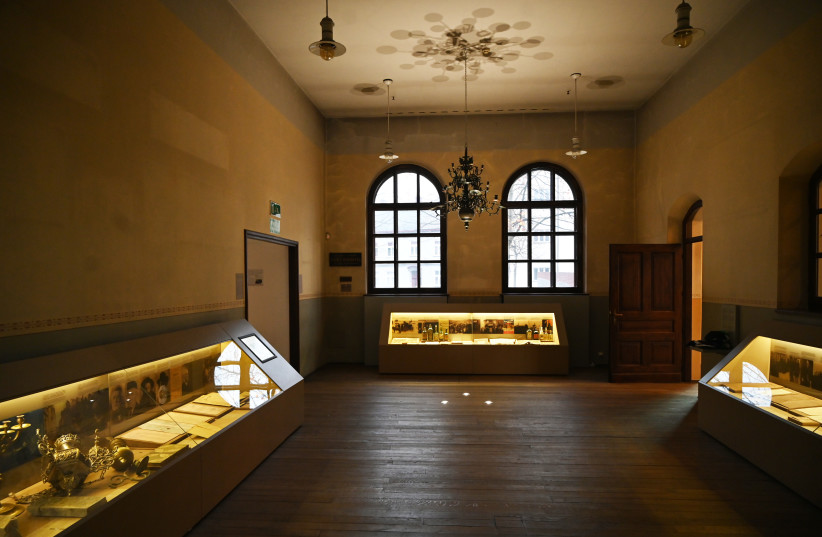
A mile from Auschwitz, restored synagogue recalls thriving Jewish life in Oswiecim
Oswiecim, less than a mile from Auschwitz, had a large, vibrant Jewish community before the Holocaust.
By CNAAN LIPHSHIZ/JTA OSWIECIM, Poland ( JTA) — In a typical, pre-pandemic year, about 2.3 million people a year visit Auschwitz, the infamous Nazi death camp where nearly 1 million Jews were murdered.About 30,000 — or roughly 1% — of them also visit a nearby museum that represents the last vestige of how Jews in the area once lived. The Auschwitz Jewish Center opened in 2000 in Oswiecim, the sleepy town less than a mile from the notorious concentration camp. It includes a museum with thousands of artifacts, a small café that also functions as a community center and a synagogue that is the only one remaining from Oswiecim's Jewish heyday. Forcenturies before the Holocaust, this town of around 40,000 situated about 30 miles east of Krakow had a large and vibrant Jewish community, with no fewer than 20 synagogues. About 8,500 of the town's pre-Holocaust population of 14,000 was Jewish.Now, not a single Jew lives in Oswiecim.But the Chevra Lomdei Mishnayot synagogue, built in 1913 and a gathering place for the few dozen local Jews who survived the Holocaust, hosts prayer services for the visitors who depart from the typical Auschwitz itinerary and venture into town. While there is no resident rabbi, the synagogue does keep a kosher Torah scroll in its ark. The permanent exhibition at the Auschwitz Jewish Center in Oswiecim, Poland features expensive chandeliers that local Jews might have hid under the floorboards. (credit: CNAAN LIPHSHIZ/JTA)"Thesort of prayer you see here, by Jewish people who had just visited Auschwitz, is often intense," added Tomasz Kuncewicz, the center's director, who is not Jewish.The museum was founded just a few months after the death of Oswiecim's last remaining Jew, Szymon Klüger.A childless Holocaust survivor who suffered from emotional problems and phobias, Klüger lived in a house adjacent to Lomdei Mishnayot. Shortly after his death, the late New York entrepreneur and philanthropist Fred Schwartz opened a museum at the synagogue. Klüger's old home was renovated and reopened as Café Bergson, a cafeteria and education center that's now part of the same institution as the museum.
"We want to represent Jewish life here before the Shoah, not the anonymity of mass death," Schwartz, who died in 2016, told the Jewish Telegraphic Agency at the opening ceremony. Over time, the museum has intersected with a community that is committed to remembering Jewish life in Oswiecim. A newly established Facebook group called "My Jewish roots are from Oswiecim" is helping connect descendants of Oswiecim Jews from around the world — and yielding artifacts and archive material for the museum."Ifit weren't for the museum, very few people would even know that a Jewish community had existed here for 400 years, its memory would have been disappeared just like what happened to thousands of communities across Poland," said Shlomi Shaked, the Facebook group's Israeli founder, whose mother was born in Oswiecim.TheFacebook group has generated unlikely connections. In September, when Miri Doron and Dana Rab-Eyal, two women from Israel, discovered they were likely related while commenting on a photo on the Facebook group showing two Jewish women in Oswiecim in 1940. And in July, when Nava Meir Kopel, a pensioner from the town of Nes Tziona near Tel Aviv, recognized her cousin, Kuba Zajdband, in a photo taken in Oswiecim in 1957 and uploaded to the Facebook group."Seeing him there is just moving beyond words," Meir Kopel wrote.Some of the Jews with roots in Oswiecim are donating family photos to the Auschwitz Jewish Center. The museum uses the artifacts it collects — from family photos and memorabilia to elaborate chandeliers found under the synagogue's floorboards, potentially hidden there by local Jews who would never return — to educate visitors. Communist authorities nationalized the building after the war, gutted it and turned it into a carpet warehouse.In 1998, the synagogue became the first piece of communal property returned by the govenment to a Polish Jewish community. The recipient community, Bielsko-Biala, later donated the space to the Auschwitz Jewish Center, which restored the original furnishings and revived it as a house of prayer."We prayed there together, with groups from all over the world, and I had a powerful, strong experience," said 20-year-old Ayalah Gura, who visited the Oswiecim synagogue with her school from Israel in 2019. "I realized that mitzvahs, Jewish culture, faith, they're all for a greater goal, a common denominator. The togetherness I experienced there was overwhelming but also positive. I felt as though I'd rediscovered Judaism and prayer."Many visitors from abroad are surprised to learn that a Jewish community even existed near the infamous camp, said Artur Szyndler, the center's resident historian."The reason many Jews settled here was the excellent railway and transportation connections here, which were ideal for factory owners," Szyndler said.He added that similar considerations led the German authorities to build here Europe's largest concentration and death camp, whose barbed wires, watchtowers and gas chambers are perhaps the world's most recognizable symbols of the Holocaust's horror. Some local Jews were used as slave laborers to build Auschwitz, which began as an internment camp for Polish non-Jews before it became an epicenter for the genocide of Jews. But most were deported to ghettos and then shipped back to be murdered in their hometown. "It's not like Oswiecim Jews had more knowledge of the Final Solution than others," Kuncewicz said, referring to the Nazi plan to murder all Jews.The Germans blew up the Great Synagogue of Oswiecim, which used to stand atop a hill not far from the museum. In 2019, the synagogue's former foundations became a monument to its past, featuring a metal box with a picture of the building amid dozens of horizontal stone slabs, signifying toppled Jewish headstones. Many Jews from Oswiecim had positive feelings toward the town before the Holocaust, according to Chaim Fischgrund, a 74-year-old teacher from Israel whose father, Avraham Baruch, grew up there."Myfather always spoke warmly of Oswiecim," Fischgrund told JTA. "He used to tell me about swimming in the river, and when I visit the place I see it through his eyes, not as a place of murder of Jews."CNN reporter Wolf Blitzer, whose father was born in Oswiecim, said that on his first visit to Auschwitz in 2015, he also visited Oswiecim. "I couldn't believe how close it was," said Blitzer, whose Jewish parents left Poland after World War II.The Jewish community of Oswiecim "was entirely typical," Kuncewicz said. "It had good relations with the town's non-Jews, a long history and a vibrant existence. The only thing unusual about it is that the Nazis built a death camp near it."
An Archaeological Dig Reignites the Debate Over the Old Testament's Historical Accuracy
Beneath a desert in Israel, a scholar and his team are unearthing astonishing new evidence of an advanced society in the time of the biblical Solomon
If you stand on one of the outcroppings of the Timna valley, the most salient fact of the place is emptiness. Here in the heat-blasted flatlands of the Arava Desert, off a lonely road in southern Israel, it seems there's nothing but stark cliffs and rock formations all the way to the jagged red wall of the Edomite Mountains across the Jordanian border. And yet the longer you spend in the Timna barrens, the more human fingerprints you begin to see. Scratches on a cliff face turn out to be, on closer investigation, 3,200-year-old hieroglyphics. On a boulder are the outlines of ghostly chariots. A tunnel vanishes into a hillside, the walls marked with the energetic strikes of bronze chisels. There were once people here, and they were looking for something. Traces of the treasure can still be seen beneath your feet, in the greenish hue of pebbles or the emerald streak across the side of a cave.
This article is a selection from the December issue of Smithsonian magazine
BUYA rock formation known as Solomon's Pillars. The discovery of a 13th-century B.C. Egyptian temple at the base of the cliffs upended historians' understanding of the site. Yadid Levy
When the Israeli archaeologist Erez Ben-Yosef arrived at the ancient copper mines of Timna, in 2009, he was 30 years old. The site wasn't on Israel's archaeological A-list, or even its B-list. It wasn't the Jerusalem of Jesus, or the famous citadel of Masada, where Jewish rebels committed suicide rather than surrender to Rome. It was the kind of place unimportant enough to be entrusted to someone with fresh credentials and no experience leading a dig.
At the time, Ben-Yosef wasn't interested in the Bible. His field was paleomagnetism, the investigation of changes in the earth's magnetic field over time, and specifically the mysterious "spike" of the tenth century B.C., when magnetism leapt higher than at any time in history for reasons that are not entirely understood. With that in mind, Ben-Yosef and his colleagues from the University of California, San Diego unpacked their shovels and brushes at the foot of a sandstone cliff and started digging.
They began to extract pieces of organic material—charcoal, a few seeds, 11 items all told—and dispatched them to a lab at Oxford University for carbon-14 dating. They didn't expect any surprises. The site had already been conclusively dated by an earlier expedition that had uncovered the ruins of a temple dedicated to an Egyptian goddess, linking the site to the empire of the pharaohs, the great power to the south. This conclusion was so firmly established that the local tourism board, in an attempt to draw visitors to this remote location, had put up kitschy statues in "walk like an Egyptian" poses.
Erez Ben-Yosef, who leads the Timna excavation, is a self-described agnostic when it comes to biblical history. So his findings have been a surprise even to him. Yadid LevyCharcoal from smelting furnaces at Timna. Such organic artifacts have led researchers to revise the site's date to the time of King Solomon. Yadid Levy
But when Ben-Yosef got the results back from Oxford they showed something else—and so began the latest revolution in the story of Timna. The ongoing excavation is now one of the most fascinating in a country renowned for its archaeology. Far from any city, ancient or modern, Timna is illuminating the time of the Hebrew Bible—and showing just how much can be found in a place that seems, at first glance, like nowhere.
On the afternoon of March 30, 1934, a dozen men stopped their camels and camped in the Arava Desert. At the time, the country was ruled by the British. The leader of the expedition was Nelson Glueck, an archaeologist from Cincinnati, Ohio, later renowned as a man of both science and religion. In the 1960s, he would be on the cover of Time magazine and, as a rabbi, deliver the benediction at John F. Kennedy's inauguration. Glueck's expedition had been riding for 11 days, surveying the wastes between the Dead Sea and the Gulf of Aqaba.
Glueck's guide was a local Bedouin chief, Sheikh Audeh ibn Jad, who struck the American archaeologist as a nearly biblical figure. "In name, which reflects that of the tribe of Gad, and in appearance, he could have been one of the Israelite chieftains who had journeyed with Moses and the children of Israel," Glueck wrote in his book about the adventure, Rivers in the Desert. The group slept on the ground covered in their robes and ate unleavened bread, like Israelites fleeing Egypt.
The archaeologist Nelson Glueck in 1965. His 1934 expedition first linked Timna's copper mines with King Solomon, but researchers later disputed his theory as fanciful. Dmitri Kessel / The Life Picture Collection / ShutterstockGuilbert GatesBlack slag, a byproduct of copper smelting, which separates the precious metal from molten ore. The slag still litters the ancient smelting sites. Yadid Levy
Strewn about were piles of black slag, fist-size chunks left over from extracting copper from ore in furnaces. The site, Glueck wrote in his original report from 1935, was no less than "the largest and richest copper mining and smelting center in the entire 'Arabah.'" It had been abandoned for millennia, but for Glueck it sprang to life.
An expert on ancient pottery, Glueck picked up sherds that were lying around and dated them back 3,000 years, to one of the most storied points of biblical history: the time of Solomon, King David's son, renowned for his wealth and wisdom. According to the Hebrew Bible, Solomon's kingdom stretched from Syria in the north to the Red Sea in the south, uniting the fractious Israelite tribes and serving as the high-water mark of Jewish power in the ancient world. And if the archaeologist's dating of the sherds was correct, he knew exactly where he was standing: King Solomon's Mines.
If that phrase gives you a jolt of excitement, as we can presume it did Glueck, it is because of the British writer H. Rider Haggard, whose 1885 novel King Solomon's Mines was a sensation. The book is set not in the Holy Land but in the fictional African kingdom of Kukuanaland. The protagonist is the adventurer Allan Quatermain, whose search for the mines leads him to the African interior and into a cathedral-size cavern, where he finds a trove of diamonds as large as eggs and gold ingots stamped with Hebrew letters. After much peril, including a near-drowning in a subterranean river, Quatermain lives to tell the tale.
The colonialist politics and ethnic stereotypes of King Solomon's Mines wouldn't cut it today, but the story entranced generations of readers and was eventually adapted for the screen no fewer than five times, from a 1919 silent version to a 2004 TV miniseries with Patrick Swayze. For kids of the 1980s, like me, the memorable version is from 1985, with the newly minted star Sharon Stone in the role of the expedition's blond and breathy damsel in distress, wearing a khaki outfit whose designer seemed oddly unconcerned with protecting her from scratches or malarial mosquitoes. There was also a guy who played Quatermain, but for some reason he made less of an impression.
In the Bible, King Solomon is said to have been rich in precious metals, and to have used vast quantities of copper for features of his Jerusalem temple, such as the "molten sea," a giant basin that rested on the backs of 12 metal oxen. But the phrase "King Solomon's mines" actually appears nowhere in the Bible. It was coined by the novelist.
Glueck, like many archaeologists then and now, had a bit of the novelist in him, which might be necessary in a profession that requires you to imagine a majestic temple based on what a normal observer would swear was just a pile of rocks. He knew that most people are attracted less to ruins than to the stories we tell about them, whether about ancient Rome or Machu Picchu. In the Holy Land, interest in archaeology is especially intense because so many of our most potent stories are set here. The biblical chronicles describe numerous battles between the polity that ruled this area, the kingdom of Edom, and the Israelites, who lived to the north. Glueck theorized that captives from those wars were sent to these mines. One natural acropolis with the remains of a wall gave him "the impression of being also a prison camp, where the drafted laborers were forcibly retained." He called the outcropping Slaves' Hill, a name it retains to this day.
A view over the flat rock formation at Timna called Slaves' Hill. Yadid LevyThe ruins of an Egyptian temple near Solomon's Pillars. Archaeologists have found thousands of cultic artifacts, including many depictions of the cow-eared goddess Hathor Yadid Levy
Proving or disproving the Bible, Glueck said, was a fool's errand. "Those people are essentially of little faith who seek through archaeological corroboration of historical source materials in the Bible to validate its religious teachings and spiritual insights," he wrote in Rivers in the Desert, and he probably should have left it there. Instead, he continued: "As a matter of fact, however, it may be categorically stated that no archaeological discovery has ever controverted a Biblical reference." In other words, archaeology didn't have to prove the Bible's account of history, but it did prove it, or at least never disproved it—and he himself, he wrote with pride, had "discovered Solomon's copper mines."
The identification stuck for 30 years, until Beno Rothenberg, who'd once been Glueck's assistant and photographer, returned in the 1950s at the head of his own archaeological expedition. A generation had passed, but enthusiastic biblical literalism was still the rule. In those days the famous Israeli archaeologist and military hero Yigael Yadin was uncovering what he identified as Solomon's imperial construction works at ancient cities like Gezer and Hatzor, proving, Yadin said, the existence of the united Israelite monarchy known from the Bible and dated to around 1000 B.C. But fashions were beginning to change.
While Glueck had identified black slag left over from copper smelting (as had the Welsh explorer John Petherick nearly a century before him), it was Rothenberg who found the actual copper mines—warrens of twisting galleries and some 9,000 vertical shafts sunk into the ground, visible from the air like polka dots. The ancient miners toiled underground to harvest the greenish ore from rich veins around the edge of the valley, chiseling it from the rock and hauling it to the surface. At the mouth of the shaft, workers loaded the ore onto donkeys or their own backs and bore it to the charcoal-burning furnaces, knee-high clay urns attached to bellows that sent up plumes of smoke from the center of the mining complex. When the smelters smashed the furnace and the molten slag flowed out, what remained were precious lumps of copper.
A reconstruction of a smelting furnace with bellows. Ore placed in the charcoal-burning chamber disintegrates. Molten slag drains out; copper remains. Yadid Levy
In 1969, Rothenberg and his crew began to excavate near a towering rock formation known as Solomon's Pillars—ironic, because the structure they uncovered ended up destroying the site's ostensible connection to the biblical king. Here they found an Egyptian temple, complete with hieroglyphic inscriptions, a text from the Book of the Dead, cat figurines and a carved face of Hathor, the Egyptian goddess, with dark-rimmed eyes and a mysterious half-smile. Not only did the temple have nothing to do with King Solomon or Israelites, it predated Solomon's kingdom by centuries—assuming such a kingdom ever existed.
If you were a rising young archaeologist in the 1970s, you were skeptical of stories about Jewish kings. The ascendant critical school in biblical scholarship, sometimes known by the general name "minimalism," was making a strong case that there was no united Israelite monarchy around 1000 B.C.—this was a fiction composed by writers working under Judean kings perhaps three centuries later. The new generation of archaeologists argued that the Israelites of 1000 B.C. were little more than Bedouin tribes, and David and Solomon, if there were such people, weren't more than local sheikhs. This was part of a more general movement in archaeology worldwide, away from romantic stories and toward a more technical approach that sought to look dispassionately at physical remains.
Illustration of King Solomon, famously rich in precious metals, in copper. The Bible describes his temple as adorned with features of copper and gold. Bill Mayer
In biblical archaeology, the best-known expression of this school's thinking for a general audience is probably The Bible Unearthed, a 2001 book by the Israeli archaeologist Israel Finkelstein, of Tel Aviv University, and the American scholar Neil Asher Silberman. Archaeology, the authors wrote, "has produced a stunning, almost encyclopedic knowledge of the material conditions, languages, societies, and historical developments of the centuries during which the traditions of ancient Israel gradually crystallized." Armed with this interpretative power, archaeologists could now scientifically evaluate the truth of biblical stories. An organized kingdom such as David's and Solomon's would have left significant settlements and buildings—but in Judea at the relevant time, the authors wrote, there were no such buildings at all, or any evidence of writing. In fact, most of the saga contained in the Bible, including stories about the "glorious empire of David and Solomon," was less a historical chronicle than "a brilliant product of the human imagination."
At Timna, then, there would be no more talk of Solomon. The real mines were reinterpreted as an Egyptian enterprise, perhaps the one mentioned in a papyrus describing the reign of Ramses III in the 12th century B.C.: "I sent forth my messengers to the country of Atika, to the great copper mines which are in this place," the pharaoh says, describing a pile of ingots he had placed under a balcony to be viewed by the people, "like wonders."
The new theory held that the mines were shut down after Egypt's empire collapsed in the civilizational cataclysm that hit the ancient world in the 12th century B.C., perhaps because of a devastating drought. This was the same crisis that saw the end of the Hittite Empire, the famed fall of Troy, and the destruction of kingdoms in Cyprus and throughout modern-day Greece. Accordingly, the mines weren't even active at the time Solomon was said to exist. Mining resumed only a millennium later, after the rise of Rome. "There is no factual and, as a matter of fact, no ancient written literary evidence of the existence of 'King Solomon's Mines,'" Rothenberg wrote.
That was the story of Timna when Erez Ben-Yosef showed up in 2009. He had spent the previous few years excavating at another copper mine, at Faynan, on the other side of the Jordanian border, at a dig run by the University of California, San Diego and Jordan's Department of Antiquities.
Ben-Yosef, 43, now teaches at Tel Aviv University. He speaks quietly, with the air of a careful observer. One of our meetings took place shortly after he'd returned from a meditation retreat at which he said nothing for ten days. He has no religious affiliation and describes himself as indifferent to the historical accuracy of the Bible. He didn't come here to prove a point, but to listen to what the place could tell him. "The mere interaction with remains left by people who lived long ago teaches us about who we are as humans and about the essence of the human experience," he told me. "It's like reading a work of literature or a book of poetry. It's not just about what happened in 900 B.C."
The dig quickly took an unexpected turn. Having assumed they were working at an Egyptian site, Ben-Yosef and his team were taken aback by the carbon-dating results of their first samples: around 1000 B.C. The next batches came back with the same date. At that time the Egyptians were long gone and the mine was supposed to be defunct—and it was the time of David and Solomon, according to biblical chronology. "For a moment we thought there might be a mistake in the carbon dating," Ben-Yosef recalled. "But then we began to see that there was a different story here than the one we knew."
Accommodating himself to the same considerations that would have guided the ancient mining schedule, Ben-Yosef comes to dig with his team in the winter, when the scorching heat subsides. The team includes scientists trying to understand the ancient metallurgical arts employed here and others analyzing what the workers ate and wore. They're helped by the remarkable preservation of organic materials in the dry heat, such as dates, shriveled but intact, found 3,000 years after they were picked.
Diana Medellin, an archaeological conservator, collects samples on Slaves' Hill, a central copper smelting site active around 1000 B.C. Yadid LevyIn addition to analyzing the soil, Medellin buries bits of modern fabric to observe how they degrade over time. Yadid Levy
When I visited the mines, Diana Medellin, an archaeological conservator, was conducting soil tests to determine how fabric deteriorates in the ground over time. Back at the labs in Tel Aviv, another scholar was analyzing chunks of the charcoal used to fuel the smelting furnaces, trying to trace the depletion of local trees, acacia and white broom, which forced the smelters to bring in wood from farther away. A few years ago the team produced one of those rare archaeology stories that migrates into pop culture: The bones of domesticated camels, they found, appear in the layers at Timna only after 930 B.C., suggesting that the animals were first introduced in the region at that time. The Bible, however, describes camels many centuries earlier, in the time of the Patriarchs—possibly an anachronism inserted by authors working much later. The story was picked up by Gawker ("The Whole Bible Thing Is B.S. Because of Camel Bones, Says Science") and made it into the CBS sitcom "The Big Bang Theory" when Sheldon, a scientist, considers using the finding to challenge his mother's Christian faith.
In the past decade, Ben-Yosef and his team have rewritten the site's biography. They say a mining expedition from Egypt was indeed here first, which explained the hieroglyphics and the temple. But the mines actually became most active after the Egyptians left, during the power vacuum created by the collapse of the regional empires. A power vacuum is good for scrappy local players, and it's precisely in this period that the Bible places Solomon's united Israelite monarchy and, crucially, its neighbor to the south, Edom.
The elusive Edomites dominated the reddish mountains and plateaus around the mines. In Hebrew and other Semitic languages, their name literally means "red." Not much is known about them. They first appear in a few ancient Egyptian records that characterize them, according to the scholar John Bartlett in his authoritative 1989 work Edom and the Edomites, "as bellicose by nature, but also as tent-dwellers, with cattle and other possessions, able to travel to Egypt when necessity arose." They seem to have been herdsmen, farmers and raiders. Unfortunately for the Edomites, most of what we do know comes from the texts composed by their rivals, the Israelites, who saw them as symbols of treachery, if also as blood relations: the father of the Edomites, the Bible records, was no less than redheaded Esau, the twin brother of the Hebrew patriarch Jacob, later renamed Israel. With the Egyptian empire out of the picture by 1000 B.C., and no record of Israelite activity nearby, "The most logical candidate for the society that operated the mines is Edom," says Ben-Yosef.
But archaeologists had found so few ruins that many doubted the existence of any kingdom here at the time in question. There were no fortified cities, no palaces, not even anything that could be called a town. The Edom of Solomon's time, many suspected, was another fiction dreamed up by later authors.
At Timna, miners extracted copper from green veins of malachite and chalcocite. The deposits, in sandstone throughout the valley and below ground, are still visible today. Yadid LevyA clay tuyère, or nozzle, that was used to direct air from the bellows into the furnace. Yadid Levy
But the dig at the Faynan copper mines, which were also active around 1000 B.C., was already producing evidence for an organized Edomite kingdom, such as advanced metallurgical tools and debris. At Timna, too, the sophistication of the people was obvious, in the remains of intense industry that can still be seen strewn around Slaves' Hill: the tons of slag, the sherds of ceramic smelting furnaces and the tuyères, discarded clay nozzles of the leather bellows, which the smelter, on his knees, would have pumped to fuel the flames. These relics are 3,000 years old, but today you can simply bend down and pick them up, as if the workers left last week. (In an animal pen off to one corner, you can also, if so inclined, run your fingers through 3,000-year-old donkey droppings.) The smelters honed their technology as decades passed, first using iron ore for flux, the material added to the furnace to assist in copper extraction, then moving to the more efficient manganese, which they also mined nearby.
The archaeologists found the bones of fish from, astonishingly, the Mediterranean, a trek of more than 100 miles across the desert. The skilled craftsmen at the furnaces got better food than the menial workers toiling in the mine shafts: delicacies such as pistachios, lentils, almonds and grapes, all of which were hauled in from afar.
A key discovery emerged in a Jerusalem lab run by Naama Sukenik, an expert in organic materials with the Israel Antiquities Authority. When excavators sifting through the slag heaps at Timna sent her tiny red-and-blue textile fragments, Sukenik and her colleagues thought the quality of the weave and dye suggested Roman aristocracy. But carbon-14 dating placed these fragments, too, around 1000 B.C., when the mines were at their height and Rome was a mere village.
Wool dating to c. 1000 B.C. The rare "royal purple" dye, derived from sea snails, suggests the smelters were wealthy and engaged in distant trade. Dafna Gazit / Israel Antiquities Authority
In 2019, Sukenik and her collaborators at Bar-Ilan University, working a hunch, dissolved samples from a tiny clump of pinkish wool found on Slaves' Hill in a chemical solution and analyzed them using a high-performance liquid chromatography device, which separates a substance into its constituent parts. She was looking for two telltale molecules: monobromoindigotin and dibromoindigotin. Even when the machine confirmed their presence, she wasn't sure she was seeing right. The color was none other than royal purple, the most expensive dye in the ancient world. Known as argaman in the Hebrew Bible, and associated with royalty and priesthood, the dye was manufactured on the Mediterranean coast in a complex process involving the glands of sea snails. People who wore royal purple were wealthy and plugged into the trade networks around the Mediterranean. If anyone was still picturing disorganized or unsophisticated nomads, they now stopped. "This was a heterogeneous society that included an elite," Sukenik told me. And that elite may well have included the copper smelters, who transformed rock into precious metal using a technique that may have seemed like a kind of magic.
Naama Sukenik, of the Israel Antiquities Authority, examines fragments of 3,000-year-old red-and-blue striped clothing recovered from the slag heaps. Yadid LevyRecovered fabrics, probably from clothing. Plant and animal dyes yield clues to the miners' technology, social hierarchy, agriculture and economy. Yadid Levy
More pieces of the puzzle appeared in the form of copper artifacts from seemingly unrelated digs elsewhere. In the Temple of Zeus at Olympia, Greece, a 2016 analysis of three-legged cauldrons revealed that the metal came from the mines in the Arava Desert, 900 miles away. And an Israeli study published this year found that several statuettes from Egyptian palaces and temples from the same period, such as a small sculpture of Pharaoh Psusennes I unearthed in a burial complex at Tanis, were also made from Arava copper. The Edomites were shipping their product across the ancient world.
It stands to reason, then, that a neighboring kingdom would make use of the same source—that the mines could have supplied King Solomon, even if these weren't exactly "King Solomon's mines." Perhaps Nelson Glueck wasn't far off the mark after all. But did Solomon's kingdom even exist, and can archaeology help us find out? Even at its height, Timna was never more than a remote and marginal outpost. But it's on these central questions that Ben-Yosef's expedition has made its most provocative contribution.
Looking at the materials and data he was collecting, Ben-Yosef faced what we might call the Timna dilemma. What the archaeologists had found was striking. But perhaps more striking was what no one had found: a town, a palace, a cemetery or homes of any kind. And yet Ben-Yosef's findings left no doubt that the people operating the mines were advanced, wealthy and organized. What was going on?
Having started out interested in paleomagnetism, Ben-Yosef stumbled into the emotionally charged field of biblical archaeology. His academic position was at Tel Aviv University, the bastion of the critical approach whose adherents are skeptical of the Bible's historical accuracy. (On the other side, in this simplified breakdown, are the "conservatives" or "maximalists" associated with the Hebrew University in Jerusalem, who claim to have identified grand structures from the time of the united Israelite monarchy, supporting the biblical narrative.) Israel Finkelstein, of TheBible Unearthed fame, was a towering figure with an office down the hall from Ben-Yosef, who was still junior faculty. The younger scholar had to tread carefully. He formulated his ideas over several years, and published them only after he got tenure.
A natural sandstone formation known as the Mushroom. The landmark is surrounded by ancient smelting sites. Yadid LevyA funerary figurine of Pharaoh Psusennes I cast from Arava copper. He ruled Egypt during the 11th century B.C. Elie Posner / The Israel Museum, Jerusalem
Archaeologists, he observed, work with objects that last centuries or millennia, primarily stone structures, and with the types of waste that accumulate in permanent settlements and survive over time. As a result, identifying an advanced society depends on the presence of such remains: the grander the buildings, the more advanced the society must have been. The rival schools of biblical archaeologists were split over whether the united Israelite kingdom was fact or fiction, arguing vehemently about whether certain ruins should be dated close to 1000 B.C. or later. But they agreed that the primary point was the existence or non-existence of buildings. They differed on the answer, in other words, but shared a faith in their ability to settle the question.
Further complicating matters, Ben-Yosef thought, was an old assumption he called the "Bedouin bias." Beginning in the 1800s, biblical archaeologists met Arab tribesmen around the Ottoman Middle East, like Audeh ibn Jad, Nelson Glueck's guide. The archaeologists concluded that ancient nomads must have been similar, not only in dress and behavior but in their resistance to central authority and to the kind of cooperative efforts required for logistical projects such as building large, permanent settlements.
But Ben-Yosef wondered why nomads 3,000 years ago would necessarily have been the same as modern Bedouin. There were other models for nomadic societies, such as the Mongols, who were organized and disciplined enough to conquer much of the known world. Perhaps the Edomites, Ben-Yosef speculated, simply moved around with the seasons, preferring tents to permanent homes and rendering themselves "archaeologically invisible." Invisible, that is, but for one fluke: Their kingdom happened to be sitting on a copper deposit. If they hadn't run a mine, leaving traces of debris in the shafts and slag heaps, we'd have no physical evidence that they ever existed.
Their mining operation, in Ben-Yosef's interpretation, reveals the workings of an advanced society, despite the absence of permanent structures. That's a significant conclusion in itself, but it becomes even more significant in biblical archaeology, because if that's true of Edom, it can also be true of the united monarchy of Israel. Biblical skeptics point out that there are no significant structures corresponding to the time in question. But one plausible explanation could be that most Israelites simply lived in tents, because they were a nation of nomads. In fact, that is how the Bible describes them—as a tribal alliance moving out of the desert and into the land of Canaan, settling down only over time. (This is sometimes obscured in Bible translations. In the Book of Kings, for example, after the Israelites celebrated Solomon's dedication of the Jerusalem Temple, some English versions record that they "went to their homes, joyful and glad." What the Hebrew actually says is they went to their "tents.") These Israelites could have been wealthy, organized and semi-nomadic, like the "invisible" Edomites. Finding nothing, in other words, didn't mean there was nothing. Archaeology was simply not going to be able to find out.
In 2019, Ben-Yosef explained his theory in a paper, "The Architectural Bias in Current Biblical Archaeology," in a journal of biblical studies, Vetus Testamentum. He followed up with a version for a general audience in the Israeli newspaper Haaretz, stirring up the contentious little world of biblical archaeology.
Israel Finkelstein, the best-known scholar of the critical school, published a response in the journal Antiguo Orientethis year, disputing the identification of the people at the mines as Edomites, dismissing some of Ben-Yosef's ideas as "not new" and others for "deficiencies" in interpretation. The same issue carried an equally detailed defense from Ben-Yosef.
The Timna formation known as the Arches. The book of Deuteronomy describes Israel as a land "out of whose hills you can dig copper." Yadid Levy
The veteran Israeli archaeologist Aren Maeir, of Bar-Ilan University, who has spent the last 25 years leading the excavation at the Philistine city of Gath (the hometown, according to the Bible, of Goliath), and who isn't identified with either school, told me that Ben-Yosef's findings made a convincing case that a nomadic people could achieve a high level of social and political complexity. He also agreed with Ben-Yosef's identification of this society as Edom. Still, he cautioned against applying Ben-Yosef's conclusions too broadly in order to make a case for the accuracy of the biblical narrative. "Because scholars have supposedly not paid enough attention to nomads and have over-emphasized architecture, that doesn't mean the united kingdom of David and Solomon was a large kingdom—there's simply no evidence of that on any level, not just the level of architecture." Nonetheless, he praised Ben-Yosef's fieldwork as "a very good excavation."
Thomas Levy, of the University of California, San Diego, one of two chief archaeologists at the Edomite copper mine at Faynan, praised the Timna excavation for providing "a beautiful picture of an Iron Age industrial landscape extending over hundreds of square kilometers." Levy conceded that both mining operations were on the fringes of the biblical action. "And yet," he said, "the work gives us a new set of hard data to interrogate ancient Israel, from the near periphery of ancient Israel. That's exciting, and it's where people haven't been looking."
But a visitor walking through the eerie formations of the Timna Valley, past the dark tunnel mouths and the enigmatic etchings, is forced to accept the limits of what we can see even when we are looking carefully. We like to think that any mystery will yield in the end: We just have to dig deeper, or build a bigger magnifying glass. But there is much that will always remain invisible.
What Ben-Yosef has produced isn't an argument for or against the historical accuracy of the Bible but a critique of his own profession. Archaeology, he argues, has overstated its authority. Entire kingdoms could exist under our noses, and archaeologists would never find a trace. Timna is an anomaly that throws into relief the limits of what we can know. The treasure of the ancient mines, it turns out, is humility.
Yadid Levy is a photographer based in Tel Aviv and Buenos Aires. His photographs have appeared in several publications, including Time and Vanity Fair.
See you tomorrow bli neder. Today is 8th and final day of Chanukah
Yehuda Lave is an author, journalist, psychologist, rabbi, spiritual teacher, and coach, with degrees in business, psychology and Jewish Law. He works with people from all walks of life and helps them in their search for greater happiness, meaning, business advice on saving money, and spiritual engagement.
The KKL-JNF Archive is offering historical photos from Israel's Chanukah celebrations. The Archive is celebrating its centennial with these rare black & white photos showing the Jews of the Land of Israel as they celebrate the holiday around the country.
Moshav Luzim, 1950 (above) Chanukah candles lit for the first time in Israel by the children of the Jewish Yemenite community of Luzim.The Moshav was established on Mount Eitan in 1950, and later on became part of Moshav Even Sapir.
Tel-Aviv, 1940 This light bulbs workshop is one of the small factories that emerged in Tel Aviv in the 1940s, and whose employees brought light to the thriving, developing Yishuv.
Cairo, Egypt 1942 Soldiers from Eretz Israel and a representative of the Cairo Jewish community preparing "Nerot Tamid" (eternal lights) made of oil and wicks. The candles were probabaly used for commemoration purposes.
Jerusalem, 1950 Lighting of a torch brought from Modi'in in a race commemorating the Maccabees, on the roof of KKL-JNF's main office in the National Institutions building. From the early 30's to the early 50's, the headquarters of the Jewish and Israeli leadership was situated in this building.
Haifa, 1955 Kindergarten children wearing a candle crown lighting Chanukah candles on mount Carmel, and contribution to the building of young Israel throuhg the KKL-JNF blue box.
Moshav Eshtaol, 1954 The Yemenite community celebrates the lighting of candles using a huge handmade Chanukah menorah. The KKL-JNF plant nursary, which provides plants and trees to be planted from the center of Israel through Yokneam, is located today near Moshav Eshtaol
Jerusalem, 1945 A representative of the young generation lighting Chanukah candles with a soldier from the Jewish Brigade, whose members have just liberated Europe at the end of World War.
Jerusalem, 1966 A woman lights Shabbat candles in Jerusalem – an ancient Jewish tradition of bringing light by women, that was sustained through all diasporas, is realized in the holy city of Jerusalem.
A rare Haggadah I just acquired tells a story of a mighty bank and the Jews that became destitute as it fell. The Haggadah was published as a promotion and with advertisements for the Bank of United States, with Yiddish ads on covers and free-ends.
The bank was the brainchild of a true rags-to-riches Jewish immigrant to the United States, Joseph S. Marcus. Born in Telz in 1862, he was schooled in Essen, immigrated to the United States at age 18, worked first as a tailor, then a businessman in the garment industry and finally as a banker. He founded Public Bank in 1906 and the Bank of United States in 1913. He was known for his philanthropy, supporting Beth Israel Hospital and the Hebrew Association for the Blind. He died on July 3, 1927. After his death his son, Bernard Marcus, headed the bank. It quickly expanded, acquiring many small banks in the New York City area and reaching 62 branches by 1930.Advertisement
On Dec 10, 1930, crowds gathered at the branch on Southern Blvd. in the Bronx, seeking to withdraw their money, and began what is considered the bank run that cascaded into other bank runs that led to the Great Depression. The New York Times reported that the run was based on a false rumor spread by a small local merchant, a holder of stock in the bank, who claimed that the bank had refused to sell his stock.
By the next day, the bank was taken over by the Superintendent of Banks, and the stock of the bank went from $91.50 to a low of $2. By the end of December 1930, 608 banks closed their doors, with the Bank of United States accounting for more than a third of the $550,000,000 deposits lost.
The ads in this Haggadah advertise the bank in Yiddish as "a bank for everyone" and "the largest, strongest bank in America," offering 4 percent interest on deposits. Despite the failure of the bank and the Great Depression, the Jewish book world did gain from the failure, as the bank building on 77 Delaney Street was taken over by the Hebrew Publishing Company. At this location, for over 40 years until 1976, millions of Jewish books, greeting cards and sheet music were published.
The contemporary history of Gush Etzion, an area about 12 miles from Jerusalem and 1.25 miles west of the Jerusalem-Hebron Road, began in 1927, when a group of Orthodox Yemenite Jews established Migdal Eder (see Genesis 35:21), a small farming community built on land that became the first modern Jewish settlement in the Judean Hills. However, the pioneers discovered that the harsh physical conditions rendered their agricultural plans impractical, if not impossible, and the Arabs attacked and totally destroyed it during the 1929 Arab riots.
In 1934, Shmuel Holtzman, a charedi businessman, established the village of Kfar Etzion, but the settlers were again driven away by the Arab riots throughout Eretz Yisrael a year later. Exhibited here is a remarkable and historic document, an original October 10, 1934, contract of sale through which Holtzman transferred 25 dunim in Kfar Etzion to one Gershon Chokin for 250 lira. Holtzman is acting on behalf of El HaHar, a corporation whose stated purpose is to organize and assist intensive Jewish settlement in the mountain region between Hebron and Jerusalem, and the buyer stipulates that he will use the land for the purpose of developing fruit tree plantations and mixed farming.
Advertisement Sample pages from an original contract for the transfer of land in Kfar Etzion (1934). First page of the contract (top half).
Seven years after the settlers were driven away by the Arab riots of 1936, the founders of Kfar Etzion, most of whom had been trained in Poland as members of the Religious Zionist movement, reestablished it as an agricultural kibbutz. Three nearby kibbutzim – Masuot Yitzchak (1945), whose members were Holocaust survivors from Eastern and Central Europe; Ein Tzurim (1946), founded by religious Bnei Akivah pioneers; and Revadim (1947), founded by Hashomer Hatzair Marxist youth – followed soon after and, by the end of 1947, these four settlements, collectively known as "Gush Etzion" (the Etzion Bloc), had a population of 163 adults and 50 children.
Orchard workers at Kfar Etzion (1947).
Although the Gush settlements had been established on land that had either been purchased by Jews or legally acquired by them, Palestinian Arabs viewed the Gush as an "alien intrusion" on their land. In its November 29, 1947, partition plan, the UN placed the entire Gush within the boundaries of the intended Arab state and forbade any Jewish settlement there.
In the wake of the partition resolution, the Palestinian Arabs doubled down on their determination to prevent the rise of a Jewish state, including particularly blockading Jerusalem and surrounding Jewish settlements, including the Gush. David Shaltiel, the district commander of the Haganah in Jerusalem, recommended that the entire Gush be evacuated and, indeed, women and children had been vacated to Jerusalem on January 5, 1948. However, Ben Gurion decided that no area would be evacuated without a fight for two reasons: first, because the Gush commanded an important strategic position on Jerusalem's southern approach from Hebron and, second, because a withdrawal would dishearten the Jewish community.
On January 14, 1948, thousands of Arabs, led by Abdul Kader El-Husseini, attacked the Gush in what they expected to be an easy victory – but while they killed some Haganah guardians, they suffered massive casualties at the hands of the few Jewish defenders and were forced to retreat. After that humiliating defeat, El-Husseini adopted a new strategy: he would wage a battle for the strategically important roads between Hebron and Jerusalem.
Notwithstanding some emergency flights from Jerusalem and Tel Aviv to the Gush, it still lacked sufficient supplies. Convoys bringing food and equipment were regularly attacked by the Arabs, who killed many of the fighters, but the most notable loss may have been on January 15, 1948, when an emergency reinforcement convoy traveling under cover of darkness was discovered and, after a fierce day-long battle, the Arabs murdered all 35 Haganah fighters and mutilated their bodies. The British, who sat passively by at the nearby police station, did not arrive until after the butchery had ended and even then did not send the bodies of "the 35" back to Jerusalem because they feared Arab retaliation. (Several decades later, a roll of film taken by a British soldier of the slaughter was discovered, but the decision was made not to publish it.)
In March 1948, the Haganah sent the "Nebi Daniel Convoy," a large fleet of 51 armored vehicles, to the Gush. It was ambushed upon its return from Kfar Etzion to Jerusalem, 15 Haganah fighters were killed during the ensuing 30-hour battle, and the remainder held out until they were extricated when the Haganah was able to secure British intervention. However, all 51 vehicles were lost, a monumental blow to the Haganah and to the defenders of both Jerusalem and the Gush, and many of them were later used by the Arabs in their final attack on Gush Etzion.
The Gush conducted several retaliatory ambushes against Arab Legion units on April 12 and May 4 that, according to the Haganah's own analysis, were responsible for changing the Legion's strategy from isolating the Gush to wiping it out. Accordingly, a joint force of Arab Legion troops armed and trained by the British launched a major attack on Kfar Etzion and, although the Haganah resisted and the attack ultimately failed, the already thin Haganah forces sustained the loss of 12 soldiers, with 30 others wounded. However, the failure of the Legion's attack made the Arabs even more determined to destroy the Gush and, as such, the Gush Etzion Massacre was launched on May 12, 1948, when two Arab Legion companies and hundreds of local Palestinian Arabs attacked Kfar Etzion.
Kibbutz residents, with the support of Haganah soldiers, held out and defended the settlement for three days before being massacred by the combined forces of the British-supplied Arab Legion and a host of local Palestinian Arabs. When Ben-Gurion announced the birth of Israel on May 14, having just learned that morning of the Etzion Massacre, he said: "The nation is jubilant – but I mourn in the midst of the rejoicing."
There are varying accounts of the precise course of events regarding the massacre of the Jews at Kfar Etzion, but the essential narrative of the Palestinian Arab war crimes varies only in some relatively unimportant details. Perhaps the most credible account are the testimonies of Yaacov Edelstein, Alisa Feuchtwanger, and brothers Nachum and Yitzchak Ben-Sira, the only four survivors who lived to tell the tale.
When the utter hopelessness of their position became evident to the 133 Haganah fighters and Jewish kibbutzniks at Kfar Etzion, they laid down their arms, put out a white flag, and lined up to surrender at the front of the German monastery. After photographing them, the Arab Legion and its local Palestinian Arab allies opened fire and killed many of them, and a group of 50 defenders who managed to escape to a cellar of the monastery were murdered when the Arabs tossed grenades into the cellar and blew up the building.
After Kfar Etzion was looted and razed to the ground, the Arabs turned their attention to an assault against the remaining three Gush settlements. Fearing – with good cause – that the Jews of these settlements would suffer the same fate as those at Kfar Etzion, Zionist leaders in Jerusalem negotiated a deal for the surrender of the settlements on condition that the Arab Legion protect the residents. The Red Cross was permitted to remove wounded Jews from the three settlements, and the Arab Legion took the remainder as "prisoners of war," who were later released from the Jordan POW camp at Mafrak in March 1949.
In an astonishing bald-faced lie, the British ambassador in Amman advised London that "the Arab Legion prevented [the] massacre of inhabitants and looting of colonies which would otherwise have been their fate at the hands of the local Arabs." The British commanding general of the Arab Legion, General John Glubb, offered several different versions regarding the events at Gush Etzion, each more ludicrous than the next. In A Soldier with the Arabs (1957), he wrote that "the Arab Legion treated all Jews as prisoners of war" and, incredibly, that "these colonies had been so aggressive that they had deliberately compelled Arab retaliation" (emphasis added). Later, writing in the July 2, 1968, London Times, he had the monumental gall to claim that "not a single Jew was massacred at Kfar Etzion."
The Red Cross reported that the Arabs had buried all the Jewish dead three days after the battle at Kfar Etzion but, when Rav Shlomo Goren, chief rabbi of the IDF, was permitted to tour the Gush in October 1949, he found that the Arabs had buried only their own fighters and had scattered the bones of the Jewish victims. In violation of every conceivable standard of morality and decency, the Arabs prohibited the burial of the bodies of the victims until the Jordanian government permitted Rav Goren to collect the remains. On November 17, 1949, half the population of Jerusalem – some 50,000 people – stood silently along the route of the procession up to Mt. Herzl, where the remains of the Jews of Kfar Etzion were buried in a mass grave, the first burial in what is today the military cemetery on Mt. Herzl.
In this agonizingly beautiful March 3, 1949, correspondence on his Chief Rabbi letterhead, Rav Yitzchak Isaac Halevi Herzog blesses the wives and children of the Jews massacred at Gush Etzion, whom he lovingly characterizes as "the redeemed of Gush Etzion," and sends his regrets that he will be unable to join their public gathering:
Rav Herzog's letter regarding the public gathering of the redeemed of Gush Etzion.
My Dear Brothers
I very much wanted to be amongst you next Sunday, may it come upon us for the good, for the public gathering of the redeemed of Gush Etzion. However, this is not possible and I ask forgiveness, and I call to them [author's note: this verse is from Isaiah 51:11]: "Those redeemed by Hashem will return and come to Zion with singing and with everlasting joy upon their heads, they shall attain joy and gladness, and sorrow and sighing shall flee." The Malbim explains: Why does [the verse] say "those redeemed by Hashem? [Because] even though we do not merit it, they will return "by the grace of Hashem." But I explain it in a different manner. Because the beginning of the Ultimate Redemption will seem to be natural [i.e., non-miraculous], therefore the prophet [Isaiah] was required to emphasize that they nonetheless will be "redeemed by Hashem," because [author's note: this verse is from Psalms 118:23] "This came from Hashem, and it was miraculous in our eyes." [And as to] "and with everlasting joy upon their heads," what is the joy that is atop the head? [It is] joy that fills the heart, yet is revealed in one's face! I raise these matters with respect to the Ultimate Redemption that is yet to come in the future, the eternal joy that is yet hovering over the heads of the redeemed [of the Gush], but it is not merely close to arriving, it is already hovering over the heads of the redeemed and over all of us.
With blessings of the Torah and blessings of Zion and Jerusalem.
After Israel recaptured the Gush area during the 1967 Six-Day War, the women and children who had been evacuated from the Gush 19 years earlier mounted a public campaign with broad popular support to reestablish Gush Etzion, and they petitioned Prime Minister Levi Eshkol to authorize it. Although the Gush was considered to be a "special case" even amongst many Israelis who generally opposed settlements in Judea and Samaria, Eshkol procrastinated in issuing a response. However, when the September 1, 1967, Arab summit in Khartoum ended with the adoption of the infamous "three nos" – no recognition of Israel, no negotiations, no peace – he advised the Gush activists that he would approve their petition. In a deeply emotional statement, he told them, "Children, you may return home," and advised them that they would be able to pray there on Rosh Hashanah, only a month later.
Kfar Etzion was re-established as a kibbutz in September 1967 as the first Israeli settlement in Judea and Samaria after the war, with the core of the new settlement comprised of 71 "children of Etzion" who had lost parents during the Massacre. As Deputy Prime Minister Yigal Alon announced, "We are back at Gush Etzion not as conquerors, but because this is part of our forefathers' land." Not surprisingly, the U.S. State Department and the UN snapped into action . . . by condemning Israel for allowing Jews to live on their own historic land.
Although, at the end of the day, the defense of the Gush in 1948 failed, the half year that its defenders held their ground and withstood Palestinian Arab attacks proved crucial to Israel's success in its War of Independence and to the birth of the Jewish state. For many months, substantial Arab forces were drawn away from Jerusalem, which is credited with saving the Jewish half of Jerusalem. As Ben-Gurion said: "I can think of no battle in the annals of the Israel Defense Forces which was more magnificent, more tragic, or more heroic than the struggle for Gush Etzion … If there exists a Jewish Jerusalem, our foremost thanks go to the defenders of Gush Etzion."
Much as, almost two centuries after the Mexican army slaughtered the Texan defenders at the Alamo, all Texans know the phrase "Remember the Alamo!" so does the Gush have broad and continuing emotional resonance as an eternal symbol of Zionist heroism and martyrdom. The date of the Gush Etzion Massacre was enshrined as Israel's Day of Remembrance, and the Jewish martyrs of the Gush will live on forever in Israel's pantheon of heroes.
See you tomorrow the final and 8th of Channaka bli neder


 Mount Ebal To its left is biblical Mount Gerizim (mountain of blessings). The large city in the valley is Nablus (biblical Shechem). For those who are unable to arrange an IDF escort to Mount Ebal itself, the next best way to experience these Biblical sites safely is from the Jewish settlement of Elon MorehPhoto Credit: Wikimedia


/https://tf-cmsv2-smithsonianmag-media.s3.amazonaws.com/filer_public/10/3b/103b2230-cf87-4e10-9df2-673b45908f23/dec2021_a17_kingsolomonsmines.jpg)
/https://tf-cmsv2-smithsonianmag-media.s3.amazonaws.com/filer_public/09/34/0934fb43-c712-496e-8103-d129cc6211c5/dec2021_a13_kingsolomonsmines.jpg)
/https://tf-cmsv2-smithsonianmag-media.s3.amazonaws.com/filer_public/a7/4c/a74c7036-25fb-423a-a992-703be1c6b8d3/dec2021_a06_kingsolomonsmines.jpg)
/https://tf-cmsv2-smithsonianmag-media.s3.amazonaws.com/filer_public/37/a9/37a91cca-fc46-4c08-89a4-589dae920d28/dec2021_a01_kingsolomonsmines.jpg)
/https://tf-cmsv2-smithsonianmag-media.s3.amazonaws.com/filer_public/58/79/5879b801-8172-4a53-8ef5-c4b1ec24f447/dec2021_a99_kingsolomonsmines.jpg)
/https://tf-cmsv2-smithsonianmag-media.s3.amazonaws.com/filer_public/8e/30/8e3061d1-820e-4e06-aa6d-5bfc2c86f39e/dec2021_a12_kingsolomonsmines.jpg)
/https://tf-cmsv2-smithsonianmag-media.s3.amazonaws.com/filer_public/18/eb/18eb5dce-e4a5-4788-98fc-63ad9b41d42f/dec2021_a21_kingsolomonsmines.jpg)
/https://tf-cmsv2-smithsonianmag-media.s3.amazonaws.com/filer_public/01/32/0132a159-59eb-4710-9137-32a92d7cf5df/dec2021_a14_kingsolomonsmines.jpg)
/https://tf-cmsv2-smithsonianmag-media.s3.amazonaws.com/filer_public/9d/76/9d767efb-5e97-42bb-b4ae-f21473bc764d/dec2021_a09_kingsolomonsmines.jpg)
/https://tf-cmsv2-smithsonianmag-media.s3.amazonaws.com/filer_public/16/be/16be4efd-55ad-47de-a303-47aed79dc214/dec2021_e02_cover.jpg)
/https://tf-cmsv2-smithsonianmag-media.s3.amazonaws.com/filer_public/17/78/1778613f-6915-4526-aff8-b3d0e4ed9657/dec2021_a15_kingsolomonsmines.jpg)
/https://tf-cmsv2-smithsonianmag-media.s3.amazonaws.com/filer_public/83/40/83403f31-38eb-44ca-9d06-8f5b95a360ee/dec2021_a18_kingsolomonsmines.jpg)
/https://tf-cmsv2-smithsonianmag-media.s3.amazonaws.com/filer_public/de/b0/deb03f31-27b4-4807-a955-1b8845eee1cf/dec2021_a10_kingsolomonsmines.jpg)
/https://tf-cmsv2-smithsonianmag-media.s3.amazonaws.com/filer_public/5c/8f/5c8f0c59-2162-46af-96cc-3dc270296a9c/dec2021_a05_kingsolomonsmines.jpg)
/https://tf-cmsv2-smithsonianmag-media.s3.amazonaws.com/filer_public/41/29/4129c979-55b8-41f0-893d-5f3490511ae3/dec2021_a19_kingsolomonsmines.jpg)
/https://tf-cmsv2-smithsonianmag-media.s3.amazonaws.com/filer_public/4a/7a/4a7a39aa-7f28-4517-aa4e-4feefcdef340/dec2021_a08_kingsolomonsmines.jpg)
/https://tf-cmsv2-smithsonianmag-media.s3.amazonaws.com/filer_public/9b/de/9bde86e3-5e2b-495e-a61d-84f181eb410f/dec2021_a07_kingsolomonsmines.jpg)
/https://tf-cmsv2-smithsonianmag-media.s3.amazonaws.com/filer_public/bd/1d/bd1d788c-c63e-4550-9a4a-eb206030551e/dec2021_a11_kingsolomonsmines.jpg)
/https://tf-cmsv2-smithsonianmag-media.s3.amazonaws.com/filer_public/03/25/0325835e-69bc-4749-8c95-d4ee8f746f60/figure.jpg)
/https://tf-cmsv2-smithsonianmag-media.s3.amazonaws.com/filer_public/b5/de/b5defff8-26b0-45fe-9b99-f19eaa76389a/dec2021_a04_kingsolomonsmines.jpg)


